Oscar Lund
Readers should be advised that this article contains references to extreme violence and suicide.
Squeezed into a packed crowd in Manchester, I waited in anticipation for Death Grips’s first onstage appearance in four years. To myself and many of the fans standing around me, the elusive industrial hip-hop band was almost a myth. The trio’s almost exclusively online presence precedes them, with rumours of violent shows and public urinations endlessly discussed among attendees. One such attendee, speaking as though Death Grips was his specialist subject on Mastermind, rattled off an exhaustive list of tracks that he hoped to hear. He, too, was very familiar with the band’s notoriety, excitedly claiming that he would be more than happy to be urinated on by band frontman Mc Ride. Although I have been a long-time fan of the group, I was not there just for the music. I was there to see Death Grips in the flesh. I wanted to see whether the almost entirely unverifiable rumours that surrounded it could be proven with my own eyes.
The set began five minutes late, met with rapturous cheering and screaming, which was drowned out only by Ride’s guttural yells and screamed lyrics. While the crowd was mercifully deprived of any sort of excretion from the stage, the set itself lived up to the hype. The band rattled through its discography, each track increasing the fervour of the crushing tide. Hundreds of people were craning their necks, desperate to catch a glimpse of the group. Bathed in a red light that obscured all but their figures, Death Grips continued to feed into its enigmatic image of hardcore intensity.
GG Allin: chaos as ideology
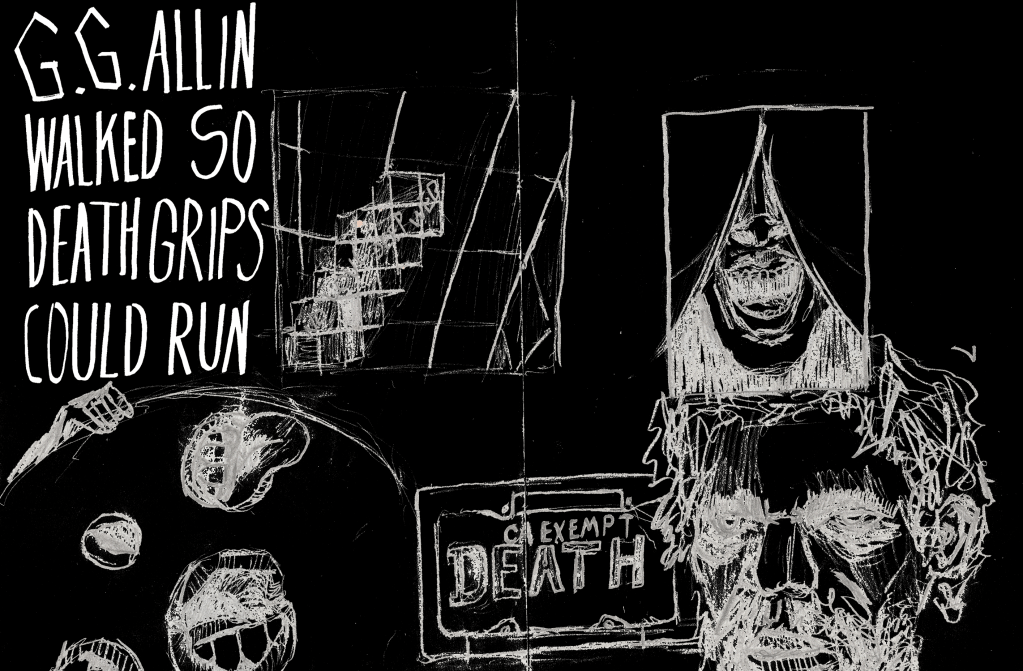
It is the band’s musical intensity and dedicated fanbase, which is fuelled by a desire for the outrageous, that reminds me of infamous punk-rocker GG Allin. Born Jesus Christ Allin, GG Allin was an American cultural phenomenon whose career spanned three decades – from the 1970s to the 1990s – until his untimely death in 1993. Allin and his brother Merle drifted across multiple bands during this time. Allin’s final band, GG Allin and the Murder Junkies, found the most success through their repulsive lyrics and hostile attitude. Much like Death Grips, Allin’s fanbase craved the obscene. However, unlike Death Grips, Allin and his murder junkies delivered filth in spades.
Speaking in a documentary released four months before his death, Allin proclaimed:
I’m trying to bring danger back to rock ‘n’ roll.
GG Allin
And danger he brought. Allin’s shows featured everything from self-mutilation and fistfights with audience members to public defecation and masturbation – all delivered to a soundtrack of murder and brutality. The self-titled commanding leader and “terrorist of rock ‘n’ roll” elevated his mediocre shock-value lyrical content into the realm of extreme performance art. Nudity was a baseline feature of Allin’s performances; both he and his drummer Donald “Dino Sex” Sachs preferred to perform without clothes, exuding pure sexual aggression to any poor soul who found themselves in the front row. A 1983 review of GG Allin and the Jabbers’ Tasteless Animal Noise perfectly encapsulates the allure of Allin’s music:
You’d probably have to see GG in person to get the full effect of his tastelessness.
The excited whisperings that surround Death Grips evokes this same desire to experience the extreme performance art that Allin delivered. Although Death Grips has never strayed into such brutal madness, the band is no stranger to controversy. The trio’s third album No Love Deep Web featured a picture of an erect penis with the album’s title scrawled on it in ink. Speaking to Spin Magazine’s Christopher Weingarten, Death Grips drummer Zach Hill revealed that the decision to use his own body as the cover for the project was “difficult to do, honestly… It’s difficult even telling people that’s the source of it; it feels sacrificial in a sense”. In this regard, Hill’s desire to sacrifice his body in service to his art is reflective of GG Allin’s claim that he would make the ultimate sacrifice on stage. Writing in 1991, Allin stated:
I will commit suicide on stage and the blood of rock ‘n’ roll will become the poison of the universe forever.
GG Allin
Self-sacrifice on the altar of music
Both Hill’s and Allin’s ideas of self-sacrifice stem from a similar root: a disaffection with the current state of the music industry. When No Love Deep Web’s release was pushed back by the band’s label Epic Records, Death Grips released it for free via social media without the label’s knowledge in an act of protest. The album’s non-commercial release, coupled with its explicit cover, was an expression of the band’s values. As stated by Hill in 2012, “nothing comes before what I want to do creatively”.
Allin, while less tactful in his delivery, shared a similar sentiment in his 1991 manifesto, in which he called out “spineless record companies kissing the mainstream’s ass, being pressured by the money media”.
The self-sabotage of No Love Deep Web was an attempt to take back control of the band’s own work. Unwilling to conform to the financial whims of its label, Death Grips gave the record away.
For Allin, it seems, his rage stemmed from a sense of cultural loss. He believed that rock ‘n’ roll had gone soft, complaining that “now we have The Ramones praising bands like Guns N’ Roses, which runs against everything they were set out to destroy”.
However, Allin’s manifesto suggests that he was more upset with his own musical mediocrity. He called for all who read the manifesto to go to their local record stores and buy all the GG Allin recordings they could find and “if they don’t have any in stock, tell them to order some”.
Unable to attain the same critical success enjoyed by his more mainstream contemporaries, Allin thought that the rock ‘n’ roll scene had moved beyond the niche he wished to fill and therefore made it his mission to bend musical tastes to fit his own or die trying.
Nevertheless, it may prove fruitless to attempt to draw a coherent ideology from an author that wrote songs titled ‘I Wanna Piss on You’ and ‘Suck My Ass It Smells’.
Aesthetics of the depraved
Allin was a deeply confused and unpredictable man, who was described by his own brother as someone who could be “normal one minute and … turn on you like an animal in the next minute”, associating himself with murderers like John Wayne Gacy without recourse or justification. While this type of anti-establishment window-dressing is also evident in the work of Death Grips – with the voice of Charles Manson featuring at the start of the Ex-Military track ‘Beware’ – its use has contextual significance. Death Grips’s use of a Charles Manson voice clip where he talks about his dislike of the American rat-race aligns with the rejection of social norms, which the band stands for. GG Allin, however, visited John Wayne Gacy in prison simply because they were friends with a shared interest. Allin’s friendship with Gacy was predicated upon a genuine admiration of his repulsive crimes, whereas Death Grips draws upon Manson’s words as they complement the musical content of ‘Beware’. In this regard, Allin can be seen as artistically lacking in comparison to Death Grips, despite their aesthetic similarities.
Death Grips: putting art first
Death Grips has taken the best of Allin – the outlandish lyrics, brutal sound and cult-like status – and turned it into something wholly its own. The group’s production and sound masterfully outstrips anything that Allin ever made.
Yet, the cultural niche remains the same. Death Grips appeals to the same sense of nonconformist rebellion expressed through non-commercial appeal.
This unabashed independence characterises Allin, but his infamy was not a product of this drive; his erratic and violent behaviour often took the front seat while his music merely served as a backdrop to his reckless personality.
The enduring appeal of Death Grips revolves around the quality of the music, with its infamous cultural presence being merely a bi-product of the band’s desire to have control over its own art, irrespective of corporate influence.