Lina Adams
Last summer, I spent one month cultivating a strict writing routine with the aim of finishing my manuscript by August. This practice consisted of mornings spent on writing, and afternoons on editing and further brainstorming. However, only a portion of that time was actually spent working, because the majority of the hours involved scanning Healthline articles for strategies on focusing, and devouring every last morsel of information that I could find on Haruki Murakami’s writing routine (I gave up shortly after learning that he swims 1,500 metres every morning to “achieve a deeper state of mind”).
In hindsight, I realised that these avoidant behaviours did not occur every so often, but rather every time I sat down to write. This hugely hampered my creativity. These habits were the perfect example of procrastination out of a fear of failure, which is a familiar tale for many creatives. I struggled – and still do – to shake the imposter syndrome that seeps into my daily life.
Upon sharing these difficulties, many people were telling me to “just be more self-compassionate” and to “stop putting so much pressure” on myself, which got me thinking. Surely that’s not an effective solution, because how would that help me to produce better work?
Of course, this increasingly digital age provides ever more avenues for artists to express themselves and promote their work. However, in an era of hyperstimulation, there is a growing need to produce for validation, which is damaging for the creative brain. Social media offers endless avenues for comparison and provides ripe conditions for burnout.
In the past, I misunderstood what it means to be truly self-compassionate because I convinced myself that my work was worthless if it was anything less than perfect. For many, perfectionism is second nature, serving as a defence mechanism against defeat. However, obsessively trying to produce your best work at all times and berating yourself for failing to get everything right on the first try and can hamper the creative process rather than nurture it; it’s a recipe for emotional exhaustion. Learning how to be kinder to yourself and managing your expectations can be a real game changer when it comes to unlocking your full creative potential.
Any field that requires you to have your work scrutinised and judged by others will naturally pose an emotional challenge, especially if your sense of self-worth as an artist is tied to your output. It is no wonder, then, that obsessive perfectionism is often a creative’s biggest affliction.
Every artist dips his brush into his own soul.
Henry Ward Beecher
I have found that by remembering my purpose behind writing (whether that be stories, articles or songs) and constantly reminding myself of the why behind it helps to keep me connected to the content of my work rather than how it might be received. By reshaping the link between your self-worth and your art, you can begin to enjoy creating again. Taking a step back to revisit your personal connection to your art can encourage you to be more adventurous.
I love making music and writing stories. Why? Because I enjoy writing about people. Everything I have learnt, I have learnt from someone else. This genuine interest in learning motivates me to tread new ground and explore other avenues that help me to understand the experiences of others (eg, podcasting and interviewing) without being anxious about how the final product might turn out.
If you’re less afraid of how you or your work is perceived, you can experiment with different ways of creating because you won’t be as hyper-fixated on the final product. Either way, you’re going to be learning and growing in an area you know and love – and that in itself is a rewarding process.
Research has shown that self-compassion can actually support the creative process and get those juices flowing. Going so far as to describe it as a ‘tool’ might be counterintuitive because it could imply that kindness is yet another capitalistic strategy for enhancing productivity. But there is no doubt that being less harsh on yourself can foster a loving, supportive environment that encourages you to explore your artistry in greater depth.
Harnessing self-compassion is by no means a process that I have nailed down. In truth, I’m still only at the beginning, but I am understanding more every day, and I am very happy that I decided to chip away at the surface.
Listen to Lina Adams’ podcast Creative License: Inside the Worlds of Rising Artists
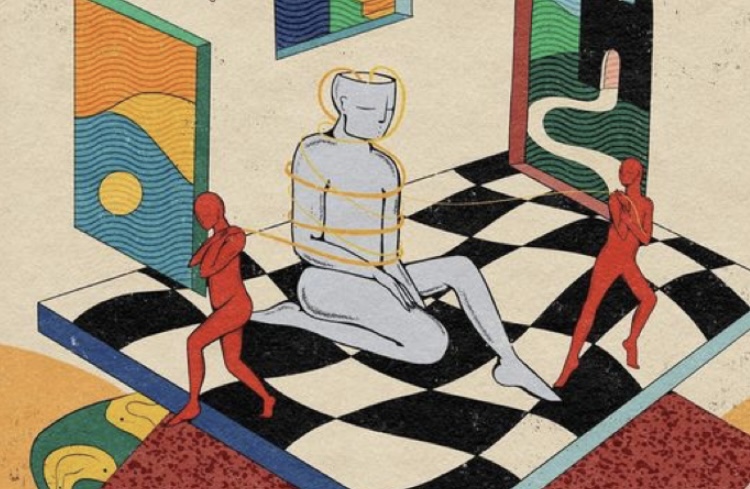
Image source: Lena Mačka (Instagram: @lenamacka)