Colm Dudley
How could a video game about a multi-faction war for power over a post-apocalyptic wasteland, fighting radioactive mutants with sci-fi weapons, be art? Good question.
Fallout: a brief history
Fallout is a role-playing video game series set in post-nuclear war America. It delights in placing 1950s and 60s enthusiasm for emerging technology and excitement for the wonders of capitalism directly within the ruins of a nursery run by robots and an energy-drink-sponsored nuclear bunker. The game is spent exploring these locations and learning the stories of those who lived and died there. Their lives are echoed through diaries, personal effects and environments.
You also fight mutant bugs and raiders with lasers and rocket powered hammers.
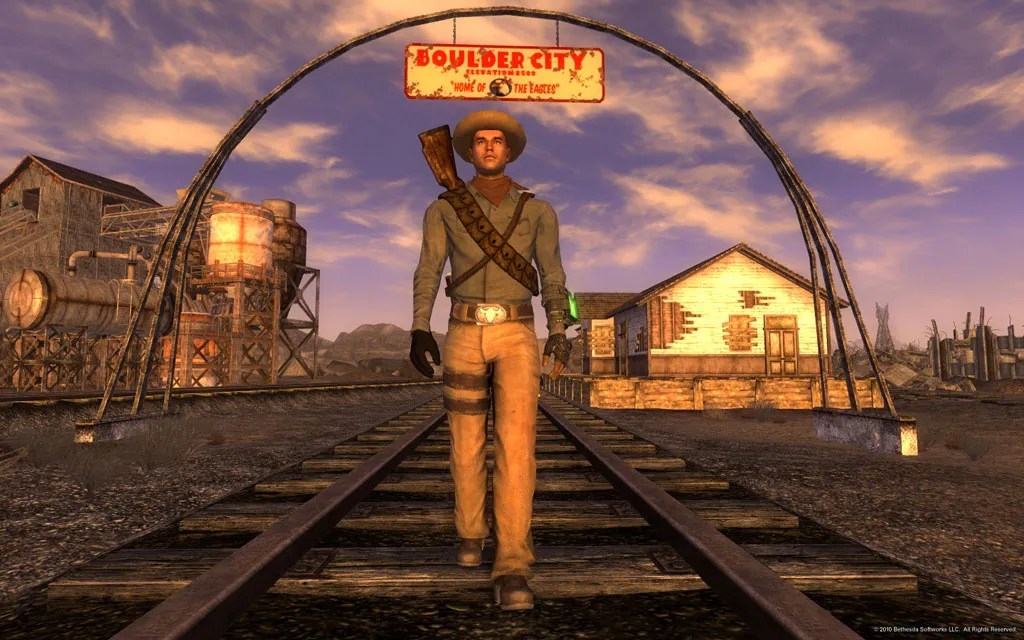
It is a cynical, silly and memorable franchise with my favourite (as I believe most will agree) being Fallout: New Vegas. As the name implies, this 2008 game is set in the remains of Las Vegas and the surrounding Mojave Desert. With the sun still shining, people still partying and the casinoes still… ‘casinoeing’, you gamble with your money and life throughout the story. The main reason why I think this game is art is due to the way it communicates these stories to the player through very little dialogue or direction, and makes them an active part of it.
One example of this is in a side story about a mysterious casino.
You’ve heard of the Sierra Madre Casino. We all have, the legend, the curses. Some foolishness about it lying in the middle of a City of Dead. A city of ghosts. Beneath a blood-red cloud… …a bright, shining monument, reaching out, luring treasure hunters to their doom. An illusion. A promise that you can change your fortunes. Begin again. Finding it, though, that’s not the hard part. It’s letting go.
Father Elijah
“Dead Money” is the name of the tale of the Sierra Madre, which was an exclusive casino set to open on the same day that the nuclear war started. When the bombs fell, the futuristic security system engaged, resulting in the extermination of extravagant guests and mistreated workers alike.
You are there to steal the treasure that is kept in the casino vault. It is prized by hunters, all of whom usually end up like the previous occupants. You battle your way through to the vault while avoiding an explosion of the bomb collar around your neck (long story) and fighting zombie gas walkers (longer story) and a mutant with a split personality (unfortunately, short story).
On your way through the casino, you encounter horrors that emerge from toxic fog and wealth artefacts still clutched in the hands of skeletons. A slow, muted piano melody follows you, interrupted only by radios playing classic 60s tunes and the snarls of creatures between walls. The world’s design could be an argument for the game being art in itself, just through the sense of dread and isolation that it can feed to the player.
The devil is in the detail
When you begin this story, you are told very little, other than “go and get gold” and a few details about the casino. The game tells the real story through computer logs, emails, character interactions and world design.
Notes are found throughout the game, such as letters to loved ones from excited guests or angry demands from employees seeking protection from unsafe working environments. You can miss these entirely if you choose, but uncovering the truth gives you a whole new perspective.
For example, the environment exhibits grand, beautiful villas surrounding the casino, which appear to have fallen apart from years of decay and neglect. However, when you read various emails found on computers, you discover that to save money, the founder cut employee pay and material costs, resulting in paper houses and glass infrastructure – a delicate notion to the fragility of wealth and desperation to maintain appearance at the cost of authenticity. It also helps the player find additional supplies.
So, through very little effort and running straight to the vault, you learn this story of the casino:
Fredrick Sinclair built the casino as an exhibition of power and wealth. He used Vera Keyes – a world-famous singer of the time – as a poster girl to get the rich and famous involved in the project. His best friend and lounge singer Dean Domino introduced him to her, and Dean is still at the casino trying to escape. During your visit you meet Dean and Christine Royce. You three have been trapped at the casino by Father Elijah, who has put you in bomb collars to force you to perform his heist for the gold inside. Without much care, this will be your interpretation of the casino and the life of the people within. You will leave with as much gold as you can carry and as many bodies left behind as possible.
However, through paying attention to your surroundings, you can discover the truth.
Fredrick built the casino as a monument of love for Vera. By following his scattered journal entries and correspondence with architects, you discover that the vault is actually a bunker designed to keep her safe and others out. The only reason that Dean Domino remains there is because he is immensely jealous of Frederick and seeks his money. This is only uncovered by breaking through his charisma and talking to him enough.
Through even more digging, you find that Frederick knew for a long time that Dean and Vera were trying to trick him out of his gold. He turned the bunker into a trap, which, once entered, would lock up and doom anyone inside. His computer entry, in which he mocks Dean, can be found and if you fail to understand it, you would end up trapped in the vault yourself.
You can even end the story here, knowing that you must escape the vault as quickly as possible.
However, when entering Vera’s penthouse suite, her tomb, you find drugs scattered across the room and her remains with the words “Let go” on the walls. You would know the truth about her illness if you had visited the medical clinic, and perhaps not have seen her as the diva she is portrayed to be. Further, when Vera confesses her guilt without provocation, Frederick relents and attempts to remove the trap. There are no pointers to where Frederick is, and his end is not revealed to you.
You will only know his true fate by reading the journals. Another skeleton in the basement. A pile of unnamed and unnoticed bones beneath his fallen kingdom.
Christine was not a mere trapped passerby. She was there to kill Father Elijah for taking the woman that she loved away from her, and has been hunting for her ever since. Only by gaining her’s and Dean’s trust and being kind to them do you help one another achieve freedom and persuade them to give up their self-sabotaging desires.
Elijah himself was not there for the gold, but for the security technology so he could claim the world for his own. Learning this, you can use his hunger for domination against him to trap him in the bunker.
These characters’ true personalities and motivations are only found through spending time talking to them and helping them. You are part of this story, not just an observer.
An opportunity to learn and evolve
To enter the vault, the spoken key phrase must be entered – lyrics from one of Vera’s songs: “Begin again, but learn when to let go”. You hear this song throughout the game; it only holds significance here if you paid attention.
All of these characters suffered because they held onto something for too long – at the cost of everything else. This idea is only further cemented when you finally reach the vault, and the heaps of gold bars are in front of you.
There is too much of it to take out before the casino collapses, and too much for anyone in Vegas to ever buy it from you. If the player has learned nothing from their experience, they are disappointed and try to cheat their way out with all of the gold, which usually ends up in their death.
But by making the effort to listen and understand the story, you realise that the most satisfying way to leave the casino and its vault is penniless with your new allies, all having finally let go.
In the end, the game treats you with great storytelling, rewards you for paying attention to it and praises you for learning from it in the epilogue. I played this game at a time when I was holding onto something that was only causing me harm, and this learning experience helped me learn how to let go.
I think this makes Fallout a piece of art. Pair that with a fight against giant robot scorpions, and I’d call it a masterpiece.