The Anonymous Art Critic
What makes art good is a contentious topic that usually gets overcomplicated. Good art makes you feel something – other than frustration at the art itself. Sometimes the feeling is joyous (Yayoi Kusama) or magical (Salvador Dali), sometimes haunting (Fransisco Goya) or visceral (Francis Bacon). Often, it is simply aesthetically pleasing (Johannes Vermeer, Claude Monet, Alfred Sisley, Georges Seurat, Paul Cézanne or John Constable). You get bonus points for the skill involved, hence why I would hold Raphael in higher esteem than Jean-Michel Basquiat or Roy Lichtenstein, despite enjoying all three.
The issue is that modern art has yet to be filtered. All art was modern once, but time acts as a relatively effective filter by directing less impressive works into obscurity. The ability to draw your own opinions is what keeps it relevant, and it is the duty of every generation to cut the wheat from the chaff. In this respect, the current crop in the Tate Modern needs considerable scything.
Sub-level exhibitions
Very occasionally, there are some original and thought-provoking installations in the Tate basement. No such luck today, which is a shame given the vastness of the space. This is a case of the frame being nicer than the picture.
Each of these rooms touched on very serious and sensitive social topics, such as racism and homophobia. When you make such serious themes the justification for what is otherwise a rather unimpressive display, it risks coming across as trivialising these topics by appearing to exploit tragedies as an excuse for a lack of creativity.
There was a light display – I have seen more interesting lamps at IKEA. We were then treated to an epilepsy trap courtesy of Nikita Gale, which was benignly absurd, and then some glass and stones opposite spelunking videos from Anna Daucikova. The power of the art is really derived from the references to transphobic attacks etched on glass. This is educational, but in the immortal words of Plane Jane, “you take away the message and what is your talent?”. I could learn more from Wikipedia.
We concluded that the space would have been better used for laser tag.
The permanent collection
We then moved to the permanent collection, where we spent the remainder of our time.
Belkis Ayón
I actually liked this art. It was distinctive and interesting, with consistent motifs. The religious references didn’t feel gratuitous.
I think this is a great example of what modern art should be; even if the art is not as purely beautiful in a classical sense, it is striking and thought provoking.
A particular highlight was “La Cena” (1991) with its reimagining of the last supper.

I was surprised that Ayón used four canvases rather than one larger canvas for the grander works. I’m sure this can be explained away by a curator as causing an intentional disconnect, but I thought it cheapened otherwise impressive works.
Studio practice
There was a solid collection of art here, perhaps because it wasn’t especially modern; it featured Cézanne and others from the late 1800s to early 1900s. This was a varied and enjoyable room. Spoiler alert: this quality did not continue for long.
In the next room, we had a video of someone taking a ring on and off. “Hands (for the eye, the hand of my body draws my portrait)” (1977) yanks me back into the present. Like a pretentious indie boyband utilising a verbose album title, this does nothing to distract from what is, really, very dull and unimpressive.
We paused by a work of Jackson Pollock. The Museum of Modern Art in New York City describes Pollock as the artist of the 20th century. To me, he is one of the four horsemen of the modern-art apocalypse (alongside Tracey Emin, Damien Hirst and Mark Rothko). You could argue that his work is distinctive. I would argue that he epitomises the self-indulgent laziness of modern art. I don’t think it’s clever nor beautiful.
Next, we ventured to Yoko Ono and reflected on the ‘celebrity artist’. There is a wealth of commentary on how art and celebrity move together, with Warhol having led the charge. I do find this topic interesting but generally feel that the more an artist chases celebrity, the less interesting their art becomes.
Ono invites us to “construct the art in our heads”. At this point, you might as well dispense with the gallery altogether.

The White Room
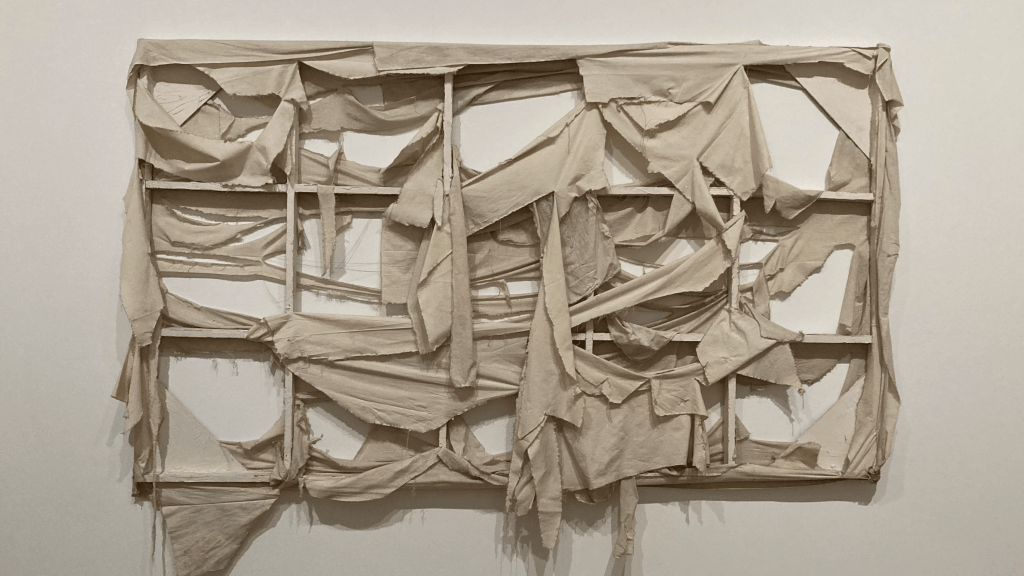
This is the good stuff. By good, I mean the absolute worst of modern art, in all of its self-indulgent excesses. We literally get to see blank canvases. This room is more an exercise in linguistic gymnastics – attempting to justify the inexplicable – than an exhibition. It is quite funny, if only for how brazen the lack of effort is.
Miscellaneous artists
Agnes Martin discovers a ruler.
Gerhard Richter proves that smearing lots of paint around on a canvas does not make interesting art.
There were some interesting blues in the Colour room, but the rest was quite dull. You can see a greater range of colours in Homebase, courtesy of Dulux.
Photography
To me, photography is the starting point for artists who can’t draw. Nowadays, the ubiquity of cameras makes it totally accessible. Perhaps too accessible. How much credit can you give to the photographer over the camera? The camera is doing the heavy lifting. Pens and brushes require such deliberation; a camera is a gun. You point and shoot.
Notwithstanding the above, some of the photos here did represent the best of photography. Gorgeous film prints immortalise cinematically framed people, places and moments.
The vast majority, however, were less impressive than your average rotating laptop screensaver.
I momentarily considered whether I could submit some of my own photos for consideration, but then I remembered that my parents don’t have any connections to the art world.
Parting thoughts
As we mingled in the Tate gift shop on our way out of the gallery (another highlight, even if only to play “guess how absurd the price is”), I reflected on what I had seen.
Despite the cutting (and tongue firmly in cheek) commentary above, I do actually quite like the Tate Modern. I used to visit a lot when I was younger, and still enjoy attending with friends today. It’s a great free venue, and always inspires spirited discussions as you wander around.
It offers a platform for a great range of diverse artists, for a broad audience (the blind included). Even if you don’t love a lot of the art, it gives you something to talk – or write – about. In this respect, whether the art is ‘good’ or ‘bad’ is irrelevant.