Daisy Packwood
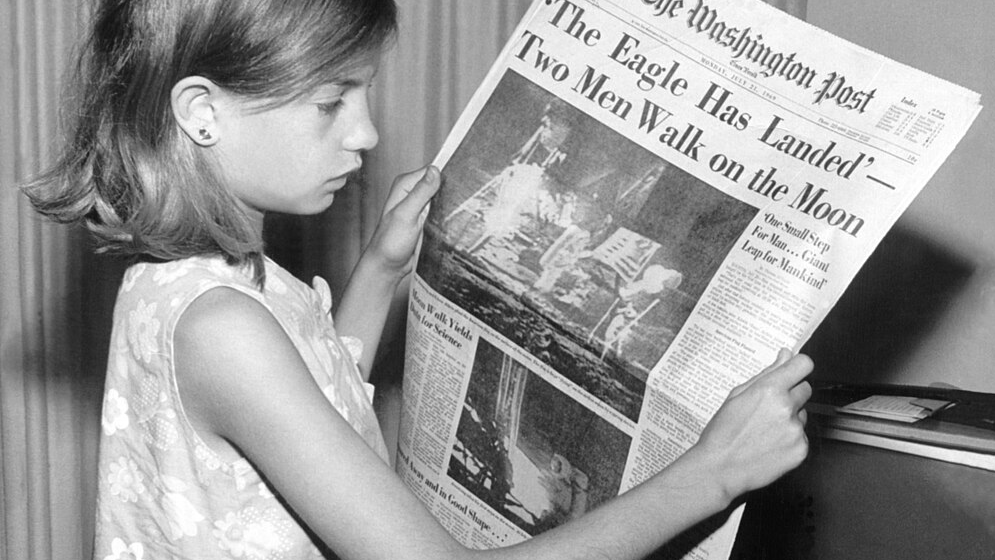
Print used to be all we had. Sleek magazines and newspapers graced coffee tables worldwide. We thumbed leisurely through copies of Hello! or Vogue while sitting idle at the hairdressers. Sunday mornings primarily saw us on a leisurely stroll down to the newsagents to fetch the morning paper.
Now, like everything, that has been replaced by technology. Now, we tap from one tab to another. Within seconds I can check in on the latest celeb news, read The Financial Times or get a detailed reading of my daily horoscope. These pocket-sized devices have supersized the news we can access on a colossal scale. While it is perhaps not the world at my fingertips, it is something dangerously close to it.
As someone who is decidedly Gen Z, I am lucky to be able to remember ‘The Time Before’ while growing up alongside the dawn of the technological age. The very first iPhone was released the same month I turned four. This worries me. Has the age-old art of print been lost to the ether?
‘Age old’ in the most literal of ways
The first newspaper in the United Kingdom, The Oxford Gazette, debuted in 1665 – a small yet meaningful occurrence that shaped the world of news. It had a cultural impact that continues to make waves. Print media influenced the music we listened to, the films we watched and the books we read. Print embedded itself into the very cultural makeup of our daily lives.
News became the way the voices of the masses were heard, documented and championed. Newspapers and magazines have been instrumental to the success of countless social movements for decades. In the United Kingdom, pro-suffrage publications (eg, The Common Cause) united supporters of the suffragettes and helped found organisations that successfully campaigned for women’s rights.
Yet sadly, since 2010, the sales of prints have declined by up 70% across the country. Print subscriptions are decreasing and ad revenue is going down. Consumers simply don’t want to pay for content they can access instantly and interact with online. So much so that if they were to solely rely on print sales, the majority of publications would be in danger of closure. As such, in recent years many titles have decided to pivot towards digital production. They have implemented online subscription services, introduced podcast formats and started YouTube channels.
A move that should not be considered wholly bad. There are many positive associations with digital article formats. Wider accessibility, real-time coverage of breaking news and diversified perspectives that come with the commenting and reposting functions are just a few advantages. There are, undeniably, many benefits to digital. The New York Times is one of many to successfully implement these changes. Since the transition, it has reached over 7.6 million digital subscribers globally.
On this, former New York Times CEO said: “The psychology inside the Times and other newspapers was that all you had to do to get a bigger audience and transfer the wonderful economics of print advertising to digital.” Yet, he disagrees, “I think it’s an important adjunct source of revenue. But I never thought it would save the Times. It had to be subscriptions”.
Keeping pace with an evolving landscape
Clearly, this is still a world we are learning to navigate. There are differing opinions on how the shift should be handled as continual steps are being taken to adjust an increasingly defunct business model. It’s the potential totality of this shift that concerns many. Evidently, a balance between the two is required. Magazines could push for a hybrid model – offering digital subscriptions alongside limited-edition prints. Magazines could introduce new and beneficial ways in which their readers can interact with their content and each other. Many have.
Vogue, for example, has steadfastly continued to publish its monthly editions – each with continued quality, glamour and insight. But, significantly, it has done so in tandem with a wide range of digital business models. Most recently, the company launched Vogue Club, which is a membership-based subscription that buys you access to behind-the-scenes content, priority access to events, early access to product collaborations and a members-only website.
Print likewise still remains a favourite for independent magazines. Many are using the novelty of the format to engage in incredibly innovative and forward-thinking editorial spreads. The Face, relaunched under new editor-in-chief Mathew Whitehouse in 2019, has seen success with its hybrid print and digital quarterly releases. Icons such as Jack Grealish, Jenna Ortega, Olivia Rodrigo and Charlie XCX have graced its cover and the publication is re-solidifying itself as a marker of modern culture, fashion and music.
The road ahead
So, sadly, print is a dying art. But it hasn’t died out completely, and doesn’t need to. It is possible to prosper as a publication that offers both print and digital services. Print offers a tangible, timeless experience that feels exclusive. The success of those aforementioned publications clearly shows that readers appreciate the artistry and depth that go into a carefully curated body of work. Digital offers intangible, easily accessible articles that provide a saturation of new coverage impossible before technological innovation.
Ultimately, it is the way that readership interacts with either format that determines success or failure. What do we as a society value most? The world of journalism and print media is changing. It is up to you as a consumer if you change with it.