Joel Thornton
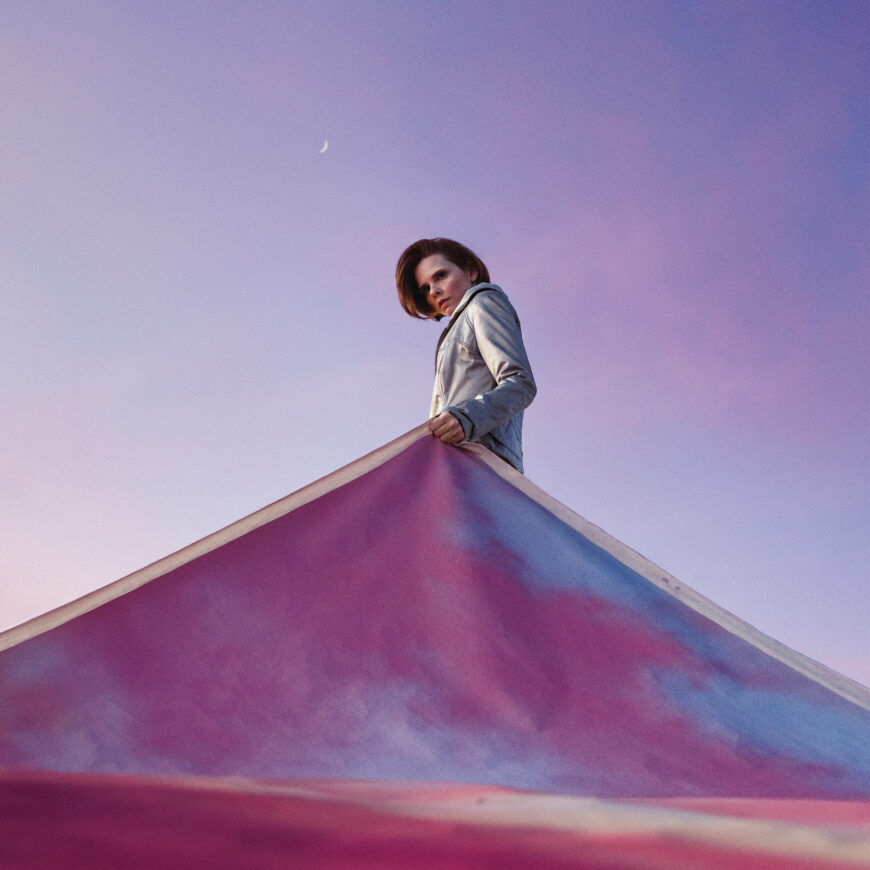
I discovered Cassandra Jenkins’ An Overview On Phenomenal Nature at a pretty crucial time. It was March 2021, and the third national covid lockdown was still underway in the UK. I was training online for a career change and generally wading through the endlessly shifting tides of shit that you do in your mid-20s, regardless of whether the world is doing well around you. It was a random click on the Spotify front page one afternoon and the cover looked nice: an ocean view with a pastel-pink sky and some illusion of light in the foreground. For whatever reason I started with track three, ‘Hard Drive’.
If you’ve ever heard that track, I’m sure you could understand how it would stick with someone who is perhaps not having the best time. I needed to hear a song about having conversations with strangers at a time when I was not having them. I had Dry Cleaning’s ‘Scratchcard Lanyard’ in pretty regular rotation then too, so this almost anthropological approach to lyric writing was clearly doing something for me. It’s very telling of my frame of mind to describe two songs from two completely different genres in such a way.
Bear in mind, this was during a period in which the UK government had sparked a debate on ‘necessary art’ with its insane ad campaign about a ballerina retraining “in cyber”; it was actively telling young artists to retrain into what it deemed to be more valuable fields. It’s worth noting that this wasn’t, in fact, the career change I was in the midst of, it was rather the opposite.
An Overview On Phenomenal Nature as a record spoke to me not only about the world outside and the people that, in better times, inhabit it, but also as a leading example of something I could point to when arguing that art has and always will be not only necessary but vital, experiential and healing.
As the intro to ‘Hard Drive’ goes: “When we lose our connection to nature, we lose our spirit, our humanity, our sense of self”.
Swap out ‘nature’ for ‘art’ for similar results.
Imperfect art for an imperfect world
Later that year, Jenkins released (An Overview On) An Overview On Phenomenal Nature, a ‘companion’ record. It’s largely demos and offshoots, first takes and part extensions, DVD extras in audio format. It’s not work I imagine anyone was crying out for, but it’s definitely in-keeping with – the style she’s cultivated around herself as an artist, somebody unafraid and also somewhat enamoured with leaving the ugly bits in for the sake of marking notable and life-affirming progression. The original album was healing for its audience, and one can imagine this was healing for the artist herself.
It reminds me of a release strategy from the previous year for another project I’d quickly fallen in love with: Adrianne Lenker’s Songs and Instrumentals, which is exactly as Part A/Part B as it sounds. Eleven hauntingly elegant tracks about love, life and loneliness for your A, and then an additional two with almost the same run time for your B – all birdsong, chimes and ambling arpeggios.
The process of changing my mind on process
I started thinking about my own relationship with art, about all the projects I’d abandoned or destroyed (or both) in a fit of anxious, insecure rage. All the things that will now never be because I couldn’t sit with a draft for too long without experiencing outright existential conflict around quality or how efficiently I’m spending my time. I began to think about process, being in the middle of the work and all the minute-to-minute problems and resolutions that are absolutely and completely part and parcel for getting anything done.
And the next time I began to work on something, I did sit there for a while. I sat with (An Overview On) An Overview On Phenomenal Nature and Instrumentals. Then it all just went away.
By and large, art should challenge us. More so, we should actively engage with complex and nuanced stories, ideas and aesthetics that will help expand our understanding of both ourselves and the world around us. But there is also a distinct place for the more delicate approach of ‘healing art’.
Last week, Jenkins put out My Light, My Massage Parlor, her newest companion record to last year’s LP My Light, My Destroyer. It is as it sounds, a reworked collection of those tracks designed and orchestrated for massage purposes. And why shouldn’t she release this? In a world of custom ASMR and 10-hour sleep-aid videos, this isn’t the novel concept it might have been a decade or so ago. It’s also the kind of thing I have no problem whacking on in the background as I write, like I might have had a decade ago. For as long as there is still meaningful self-exploration to be done at the centre of an experience, it’s alright by me. These companion records, quickly becoming a hallmark of her output, are the logical landing place of an artist that ardently believes in healing as a vehicle of greater self-exploration, and one that made me believe too.