Joel Thornton
Ari Aster might be the biggest ‘one to watch’ director of the last 10 years. He arrived in a big way with two instant classics, Hereditary (2018) and Midsommar (2019), both of which were released to widespread critical acclaim. Audiences were drawn to the emergent hallmark of his work: modern allegorical fiction for the psych-horror generation, who were burnt out on jump scares and more than happy to watch a filmmaker build tangible dread. Aster became known for utilising real-life terrors (eg, generational trauma and survivor’s guilt) in settings an arm’s length away from our world and still managing to have those topics justifiably and notably be the true horror of whatever carnage was going on around them.
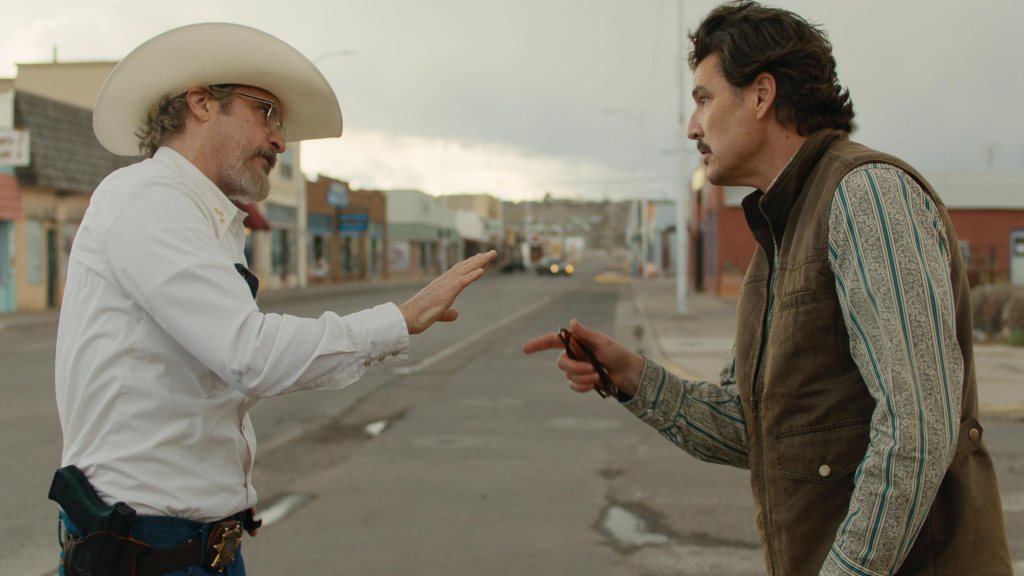
Well, with all that said, his newest project Eddington (2025) takes on the beloved and not-at-all terrifying year of 2020, and follows the internal politics of a fictional small town in New Mexico, as its sheriff (Joaquin Phoenix) and mayor (Pedro Pascal) wrestle with the burgeoning pandemic and the other’s views on how to best handle it.
I should note here that Eddington is not a horror film – but in a way that lets the cat out of the bag early, it’s not really an anything film. I’ve seen it described as a “political thriller” in the marketing material, but it would be remiss of me to allow you to go into it thinking it was that.
The absolute worst offence is that anything compelling within the first 80 (yes, 80) minutes –when it’s still walking the beaten path of a character drama (albeit coasting on a pretty limited scope of motivations and interactions) – seems to be done away with out of spite. I say this because there’s no way that the writer’s negligence on its own would get you to the second half of the script. Beyond the half-way mark, the film fractures in a way that is incoherent even with itself on a minute-to-minute basis. It doesn’t happen because all hell breaks loose in the town (even though it does) because there would still be ways of foreshadowing and landing that – that stayed in the desired lane and pulled off the desired effect. Instead, it moves from being awkward and lethargic (an aesthetic in its own right) in its obsession with being dry and more clever than you, to twists upon twists upon twists because it’s more clever than you.
The fundamental issue is that the film has nothing at all to say, and yet it insists on attempting to hit on every single socio-political conflict and talking point of the last half a decade in some contrived way or another. The pandemic was, of course, not the only major news event of 2020 by a long shot, and there’s a litany of inane visual ‘gags’ that are decidedly not visual storytelling, but rather ‘hey, remember this?’. The killer hornets flash up on somebody’s news feed for a second or two, and in one scene the mayor walks around his home that’s filled with hoarded toilet paper.
Radicalisation, the cultification of the online space, institutional racism, nationalism, sexual abuse – I think everyone would agree these are all topics that require a hell of a lot of dignity to manoeuvre around. They are set-dressing in Eddington.
Nothing is condoned nor endorsed; I can’t think why any filmmaker would elect to incorporate such complex topics without making some kind of statement about them. For this reason, the characters of the town of Eddington don’t ever feel like characters – more like Aster himself musing through their mouths. The performances of Phoenix and Pascal are convincingly vitriolic, but that’s the lion’s share of what they get to work with. So, are they presented as straw men? As ideologues for their respective causes and/or objects of satire? Of course not, that would require Aster to muse about something meaningful. If their one-dimensionality was truly intended, I can’t help but feel there’s a way to approach creating cardboard cut-out characters that would yield greater results, instead of them merely being a consequence of a script that is too busy to get a coherent thought out. I’m thinking of the stunted dialogue, uncanny cadences and achingly long pauses in Yorgos Lanthimos’ The Killing of a Sacred Deer (2017), for example.
Execution is the name of the game, and Eddington seems like two or three scripts’ worth of ideas hastily banded together with nobody saying no. Despite this, it still manages to be unfathomably uninteresting, periodically unfunny and doing way too much for a film that can’t seem to resolve anything in a fashion that changes a character or 10. This time around, the very subject matter is at arm’s length, and you’ll feel it.