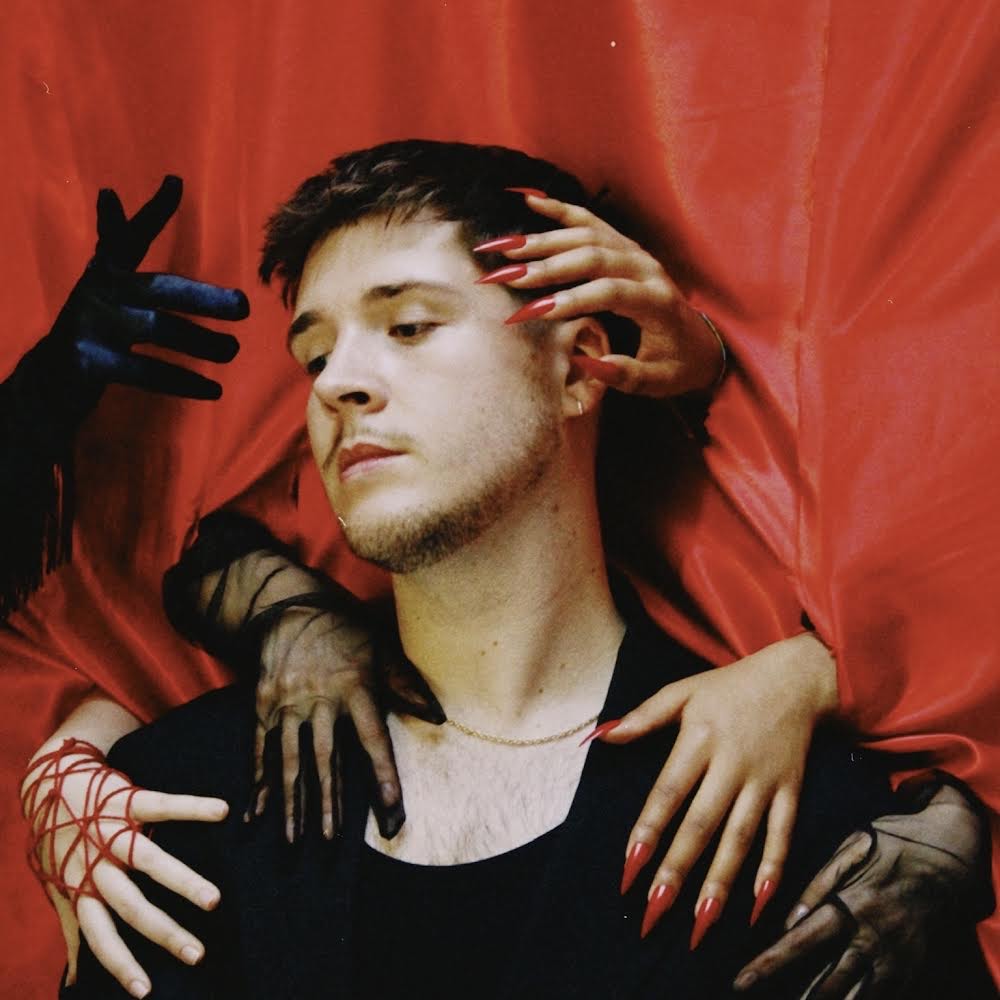
Sienna Bentley
Bradley Jago is rewriting the rules of soul pop. With a voice that channels raw vulnerability into cinematic grandeur and a mission to carve space for queer souls in a genre often dominated by tradition, Jago stands as one of the UK’s most rebellious emerging artists. It was my pleasure to sit down with him for a second time as he gets bigger, better and bolder.
You can read our first interview with Bradley Jago here.
Can you walk us through your creative process – how do you translate deeply personal experiences into cinematic soul-pop songs without losing their raw authenticity?
I usually start with myself and a pianist, and I come to the session with sounds I like and my notebook. I have a massive private notes tab on my phone that honestly must have more than 1000 lyrics and song ideas. Some are just titles, others are fully formed songs, but I add to it most days when inspiration strikes. I either choose one of those to start from, or see where the music takes me.
This is where the basic song is written, but then I take it to a producer and we make a demo. Play it to lots of friends, change the demo, record some live instruments, record final vocals. Then it’s a few weeks of back and forth on the mix and master. It’s actually quite a long process; before I decide whether to record final instruments and vocals, I like to live with the song for a bit to see if I’m going to go off it or if it feels timeless.
You’ve described your work as “queer soul for queer souls”. Do you see this as a genre in itself, and how does positioning your music this way challenge the industry’s tendency to box artists into rigid categories?
Personally, yes, I do – a genre within a genre. People might listen to my music and just hear a soul-pop blend, but if you’re queer, I’d hope you hear it differently. It’s in the intricate stories and cultural references. I’ve actually found that the industry loves a label… they’re not always the broadest thinkers, so if you can lay it out for them, they’re more likely to pick it up.
With your work being positioned as this safe space, what impact do you hope your music has on queer representation in the wider soul-pop scene?
I just want to make music I would absolutely love if I heard it. Before I started writing, I couldn’t find much music that spoke so explicitly about queer experiences. Of course, there have always been queer soul artists, but for one reason or another the queerness typically gets diluted down, in my opinion.
I’ve also seen a change of tides in the last five-ish years – life doesn’t feel as hopeful for queer people right now. I think music needs to reflect this, because it’s always been political and reflective of the culture.
Soul-pop isn’t always in the mainstream spotlight. What challenges and opportunities come with making space in this niche, and how do you see your identity shaping the genre’s future?
I think I naturally write pop-leaning melodies over soul sounds because I listen to so much of both genres. I think with soul music especially, there’s a real need for the UK community to rally behind it. It is such a beloved genre, but I don’t think it fits into the new era of social media promotion as well as other genres do, because there tends to be less ‘big drops’ musically for video transitions, for example.
I also think it can be seen as slightly inaccessible because it’s often marketed in a retro and expensive way. I hope centring relatable stories makes the genre feel more accessible to those who maybe would have otherwise ignored it.
Off the back of that, operating in a niche genre means you’re not chasing chart song-writing formulas. What risks have you taken sonically that you feel mainstream artists wouldn’t dare, and how have audiences responded?
I love a long song! Give me a seven-minute brooding ballad, I’m so there for it. Of course, I do think about listenability and try to steer away from self-indulgence, but I do love the freedom of being able to experiment more. On the next EP, I think people might be surprised with how far I’ve pushed soul in each direction. I loved making ‘Bound To You’ and ‘Bound To Happen’ that I dropped in autumn 2024, because it was two versions of the same song, released at the same time. I totally could have called one a remix to make it more understandable to the industry, but the meaning had a duality and they needed to be released together as a mini project.
How do you balance building a safe space for queer listeners with the pressure to grow your career in a competitive industry?
I have a gorg group chat on Instagram where I talk to my listeners and they talk to one another. When it comes to performing live, I trust that the crowd will be full of lovely people, and they always are. They want to connect and be in the moment. It’s something that up until now has naturally happened, and I think because I write music for my own peace of mind, that is never going to feel exploitative in a way.
You’ve cited artists like Adele, Amy Winehouse and Leon Bridges as inspirations. How do you consciously weave these influences into your sound while ensuring your music remains distinctly your own?
To be honest, I don’t know if I consciously weave these influences into my sound, because I think they are subconsciously always affecting how I write and perform. I sometimes watch live videos back and think, “wow, that’s such an Adele-ism”. Having said that, I do reference Adele in pretty much every song-writing session I have; she’s making music I wish I had made. I’ve learned that I definitely prefer to work on a body of music rather than singles, and this allows me to steer close to references. I know each song in the project will sound totally different, so I don’t mind if people say they can really hear Amy Winehouse’s influence on one song. If they said a whole project was similar, then I’d be disappointed. I always want to be pushing the genre forward in some way.
Your most recent release, ‘Killer Queen’, explores the thrill and danger of falling in love without defences. What was the most challenging aspect of writing and producing this track, and how does it set the tone for your upcoming EP?
I usually write a lot of my songs with time on my side – as in, I’m writing about something that has happened to me in the past. But with this one, I was writing in real time. I was feeling these feelings in my new relationship and thinking, “am I crazy or is he crazy?” That was hard because I didn’t have the privilege of processing how I felt about the situation with reflection. I had to honour the moment I was in as important and honest, even if it does change over time.
‘Killer Queen’ is definitely the most fun and tongue-in-cheek song. The rest of the EP is darker, moodier and heavier, so I feel it lulls the listeners into a false sense of security. But this is on purpose; I want the listener to experience this spiral into self-doubt that I went through while writing it.
With ‘Killer Queen’ accompanied by a striking visualiser, how important is the visual dimension of your artistry?
I definitely think the visual helps tell my story and helps the listener understand what I was feeling. But the beauty of music is that it’s also for you to interpret and relate in your own way. I want people to assign their own meaning to phrases. But there’s also magic in watching a visualiser spell out exactly how you’re feeling in a situation with music and visuals that are extra striking.
With your next EP due in March 2026, what themes or sonic directions can fans expect, and how does this project push your artistry beyond what you’ve already shared?
The whole EP feels so recent. There’s not a lot of looking back; it’s a lot of now. It’s rooted in soul, but draws from a lot of different genres. It’s ballads, spoken melodies, strings, saxophone, choirs – so many different sounds to reflect a turbulent time in my head. I always say that I want to push the genre forward, and I don’t think I necessarily always do that sonically because I love classic sounds, but I hope that I do in terms of representation and narrative. I want soul music that centres queerness, and that’s my only hope for this EP.