Sienna Bentley
“This whole time I couldn’t stop thinking about watches.”
Person D
“Back in my day…” Good Lord. I can’t believe it’s gotten to this point, but here I am. Reminiscing on the good old days at the ripe age of 25.
I can still remember the tech-free days of my youth – and sadly, I suspect that I am part of the last generation that will be able to say that. I think we’re searching for the nostalgia of a time that many of us can still recall as it slips further and further from our collective grasp. With the world and the answers to (most of) life’s big questions at our fingertips and sitting like rocks in our pockets, and with the temptation to doom-scroll and sift through years of content in half an hour, we’re no longer living tangibly and we’re losing connection in the process.
When I was in Seoul last October (yes, I’m bringing that up again), I was amazed by how technologically advanced it was, with pedestrian stop lights illuminating the sides of the roads. The green man had melted into a green dotted line on the pavement. I thought this was cool until my friend pointed out that it was because almost everyone is too busy staring down at their phones.
But there’s been a marked shift – particularly in Gen-Z, who, it seems, are craving a break from existing almost exclusively in the online space. People seem to be moving towards embracing the physical to live more tangible, real lives rather than through a screen. Whether this is out of protest, protection or pretence (or perhaps all of the above), it’s official: analogue is making a comeback.
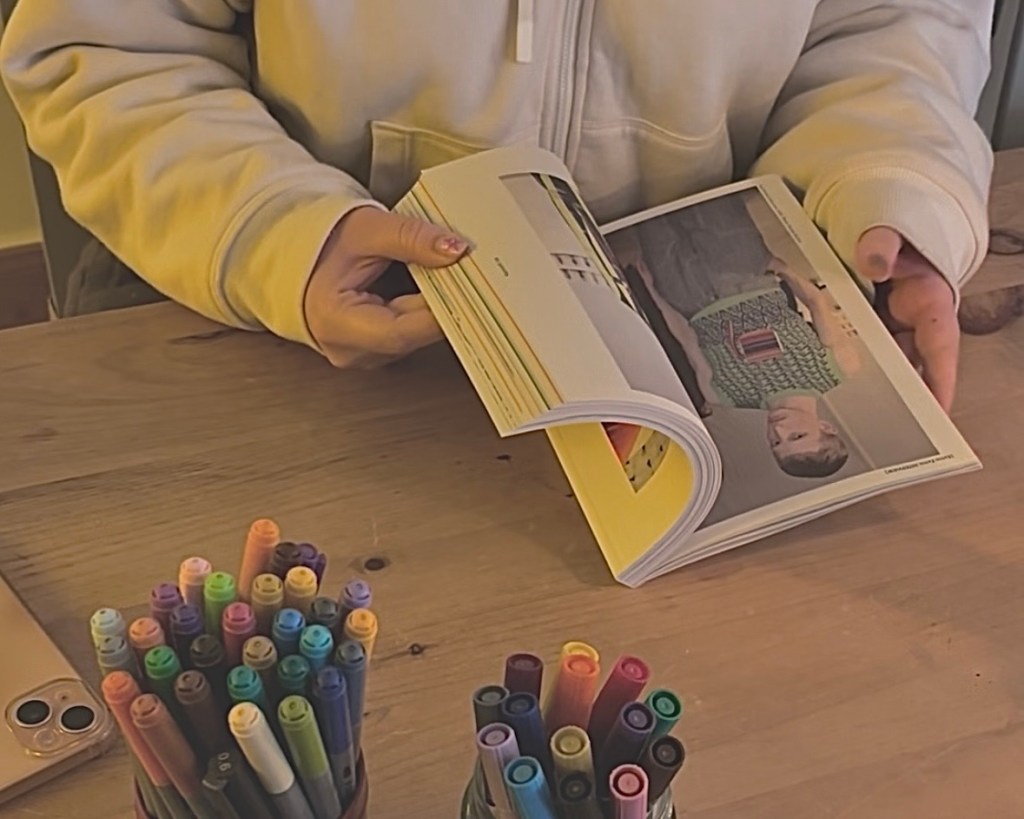
I am, naturally, all for this (and not just because I make magazines). You don’t have to read many of my articles on this site to understand that I want to encourage people to try new creative activities, get out of their comfort zones, make mistakes. If it stems from wanting to romanticise your life, that’s fine. The fact that more people are wanting to use their hands and make art and read print media? Sensational. (I’ve been saying print is not dead, and no one believed me. If nothing else, let the message here be that I’m always right.)
I suppose the question is whether the analogue era is here to stay. Is it really about rejecting the digitisation of reality, or just appearing like we are?
So, I’ve asked around (because why do all the heavy lifting myself?) about this sudden movement and what it means for all of us. I wanted to know the changes that others are implementing in this new wave and the impact it’s having on their lives, and on us as a collective.
So here you have it: five takes – including mine, you’ll be pleased to hear – on the analogue re-revolution.
Do you see engaging with analogue as a form of rebellion, self-care or something else entirely?
Person A: ‘Analogue’ as a medium never went anywhere, but it did lose our attention. Sometimes just sitting with silence feels like swimming against the current – particularly in public places where most seem to be looking down at their screens. Focus and meditation helps me recalibrate and sharpen my attention, though I have a long way to go.
Person B: Maybe rebellion is too strong a word; I see it as a counter to the world of technology and the future because I feel like we are told to use tech for things we don’t need to use it for, and it doesn’t necessarily benefit us. I also like the old school and the physical: journals over notes apps, using a chess board rather than chess.com. It’s self-care and an attempt to keep the old school alive.
Person C: I have friends who say they don’t write anymore – they type everything – but I find it extremely important to continue hand writing. It’s an act of expression. We all have different handwriting and I’d hate to lose that way of expressing myself. Words flow differently. Goodbye MoonPig, hello handmade and handwritten birthday cards!
I also find reading from a real book to be an act of self-care. I love the physical page turn, I love having the cover, it feels like I’m advertising something I actually enjoy rather than being anonymous with a Kindle.
In terms of rebellion, I’m pro-cinema. I want to support the cinemas, I don’t want to just pay for streaming when it is the lower form of an art that I love.
Person D: It’s more for variety than any form of rebellion – it provides something different. It’s not out of rage against the digital.
My thoughts (yes, I am still doing some of the lifting): Using my hands to make things forces me to focus and I lose myself in it. It allows me to turn my brain off for a while. Generally, being creative is a form of self-care for me simply because I think I’d go nuts if I wasn’t able to make art or music.
But it’s also rebellion. We’re living in a digital world where we’re all addicted to our phones and I don’t want to be part of the problem anymore. People are turning to vinyl and CDs instead of streaming platforms and I wonder how much of that is an act of rebellion, in protest against companies that hurt artists by not paying them fairly and use their millions to fund wars…
How does slowing down with analogue tools change the way you think or feel?
Person A: Looking up at the world around us is crucial if we want to remain inspired by normal life happenings. Limiting the amount of times I use headphones to block out the world has been a great method of calming down my nervous system.
Person B: It makes me feel more engaged with what I’m doing. Take reading for example, I’m way less likely to pick up a Kindle over a book because I like the way it feels, it’s pleasing to the senses. I get more enjoyment out of it and it makes me feel like I have more intention behind what I’m doing.
Person C: Journaling makes me feel at peace, like my body is creating these thoughts. It helps me to slow down and remove myself from the fast-paced life of texting or emailing. Analogue makes me think of those that have used it before me. My dad was a DJ in his youth, before he had me. He isn’t well now, so imagining him announcing and putting on records and having thousands at his house makes me feel grounded. Borrowing books from my mum and seeing inscriptions of “happy Christmas my love” from 1991 makes my reading experience historic, it makes it generationally enjoyed. It just doesn’t feel the same with the non-physical. I appreciate tangible media more; it adds to the whole experience and I physically and emotionally carry it with me.
Person D: It helps me to focus, to practice concentrating on only one thing at a time and giving that more attention.
My thoughts: On New Year’s Day, I woke up feeling anxious. We spent the whole day cutting up old magazines to create vision boards and I noticed afterwards that I felt calmer; I was focused on the task at hand. My brain wasn’t buzzing with thoughts, I wasn’t staring at a screen and it felt so good to use my time being creative.
What do you think Gen-Z is craving that digital life isn’t giving them?
Person A: Connection, conversation, spontaneity, talking to strangers, romantic meet-cutes, little miracles, tiny joys in the mundane.
Person B: Ownership. Especially with music, streaming platforms have killed exclusivity; you don’t own the albums that you add to your library. If you buy a record or CD and build a collection, that’s yours. You’re giving technology the power to dictate how you use and collect media. You pay £10 a month to have a library and, sure, it’s convenient, but they could just remove it if they wanted to.
Person C: Meaningful experiences, privacy. Individuality and a lack of comparison. Social media deprives us of all that. YEARNING IS GONE AND REPLACED WITH ENVY OVER LIVES NOT YET LIVED.
Person D: I didn’t know Gen-Z was craving analogue, but I also don’t consider myself Gen-Z.
(Sorry, you are.)
My thoughts: I think we romanticise the past and are nostalgic for perhaps even a time that we didn’t experience – a time before the tech. I hope it’s connection (rather than just the appearance, perception or idea of it) that people are searching for.
Do you think analogue culture is a temporary trend or long-term shift?
Person A: A slow but big shift appears to be happening. Parents are avoiding using screens as distractions for their kids (in some cases), young adults are limiting their screen time and people are craving third spaces. I like to believe we are collectively working on reversing our screen addictions.
Person B: It depends who you ask. Some people will think that as tech advances there will be a greater pushback, but those who are half-arsed will see going analogue as more of an effort. I’d like to think it’s the former and people will be more involved as time goes on and it won’t just die out, but our generation is so vulnerable to trends. Like with buying vintage clothes, it’s ‘cool’ to do that right now, and I don’t want that to be the reason why people pick it up as an interest.
Person C: I think some of it is temporary. Like with vinyl: unless you’re willing to invest in higher-quality sound systems, it objectively sounds pretty dire coming out of a cheaper record player. However, I think the theatre of watching this amazing thing occur before your eyes – a needle scratching a disc and playing classics – is amazing and timeless. It will never not be amazing. Whereas with digital, you don’t know everything that’s going into that. You see your phone every day so you become desensitised to this compact wonder that a phone is. As the world shifts more towards this kind of tech, it becomes less exciting than how I imagine it was when it first came out. But for those that are digitally native, it’s boring!
Person D: I think it’s a long-term shift from those of a certain age, but digitalisation will always be exciting in youth. I suspect that a tendency towards analogue comes with maturity and the inherent calmness of that.
My thoughts: I’m worried that the shift towards analogue – using film cameras, buying vinyl, etc – is a fad or that people are more concerned about looking ‘cool’ and being perceived as more analogue than actually embracing it because it’s important.
I also think that the impact of the recession will have (or is having) a double-edged effect: people turned more to DIY methods to create their Christmas decorations in 2025, but going full-tilt-analogue-everything can be incredibly expensive. Vinyl and camera film aren’t cheap.
What analogue habits are you adopting in 2026?
Person A: Journaling will be a continued source of therapy for me. Handwriting changes slightly based on how you feel (or so I’ve found) so the personality of my very messy handwriting brings me some entertainment. Forgetting about perfectionism when it comes to journaling is so important. Let your brain spill out everywhere.
Person B: Buying more physical music; even though I haven’t got a record player I am buying records. I’m going to continue journaling, I have taken up chess on a physical board. Playing more board games, taking a pack of cards to the pub… things I’ve always liked but want to force people to do with me. Buying more secondhand books and vintage magazines to have more physical media in my house.
Person C: This year I’m moving away from panic-Googling a recipe on BBC Good Food just to use food I have in the fridge and I’m intentionally using recipe books, which I have curated for years, and cooking with them to make better food and trial my culinary skills!
Person D: Physical books and writing things down. In fact, I wrote down my 2026 goals on paper instead of using my notes app. I generally want to start writing notes in a pad for things like work over apps like OneNote.
My thoughts: I want to embrace more physical print media (hello, upcoming bite mag print issue), write my shopping list on paper and carry a little notebook around for when inspiration strikes. I used to have a special book for song writing, whereas now I tend to revert to my notes app. I have a love-hate relationship with journaling but I know it’s something I need to pick up again.
My mum writes in a book all of her traditional Norwegian recipes that were passed down to her – I’m a horrendous baker (too scientific for me), but I think it’s important to be able to pass knowledge down like this, lest it – and the connection – be lost.
How do you navigate the pressure to be constantly reachable?
Person A: ‘Do Not Disturb’ is a helpful tool but also an important boundary. Being available over the phone 24/7 can feel like a violation. Stay private, don’t tell all and leave your phone at home. All things I need to practice myself.
Person B: ‘Do Not Disturb’. Airplane mode. Trying not to feel the pressure to reply instantly. Putting my phone in a different room – obviously they can still message me but I won’t be as tempted to check my phone. In terms of having a healthy relationship with tech in general, on weekends I don’t look at my phone for the first hour of the day. It trains your brain out of the phone addiction.
Person C: ‘Do Not Disturb’ is my go-to when I feel stressed. I’m not good at turning off my phone so I put that on when I don’t want to check it. I’m good at meeting up with friends so texting is a lesser issue but a goal for me this year is to try not to spend all evening texting. It’s hard because as the digital world gets larger, the physical world gets smaller, which is great for me as I have friends living on the other side of the world and in different parts of the country. I love FaceTime, I love playing games together. I guess the pleasure of constantly being reachable is often greater than the pressure for me.
Person D: I semi-regularly ignore all messages for a 48 to 72-hour period in order to reduce the frequency of communication with people and therefore the number of instances where I feel pressure like that.
My thoughts: I think it’s clear when I’m not feeling sociable because I stop responding and go into a sort of hibernation ghost mode – and that stresses me out in a different way because I don’t want anyone to think I’m being rude. But I don’t think we should be accessible all the time. It doesn’t feel natural. I do my best to reply when I can, but sometimes you have to just protect your peace.