Louis Greaves
The ground shakes. The rumble of distant explosions fills the salty air. Through the midday haze, fountains of sea foam erupt from the backs of monsters. Two figures are in the firing line of the next barrelling wall of water. They begin to paddle.
Banana Point, Morocco. Twenty minutes north of Agadir, this barren cliff is surrounded by the bustling surf villages Tamraght and Taghazout, lush plantations and the now furious North Atlantic ocean to the west.
Yesterday, paddleboarders splashed innocently at its feet and local fishermen cast their lines out from the rocks, hoping to snag the fruits of the sea. Today, this garden has thorns.
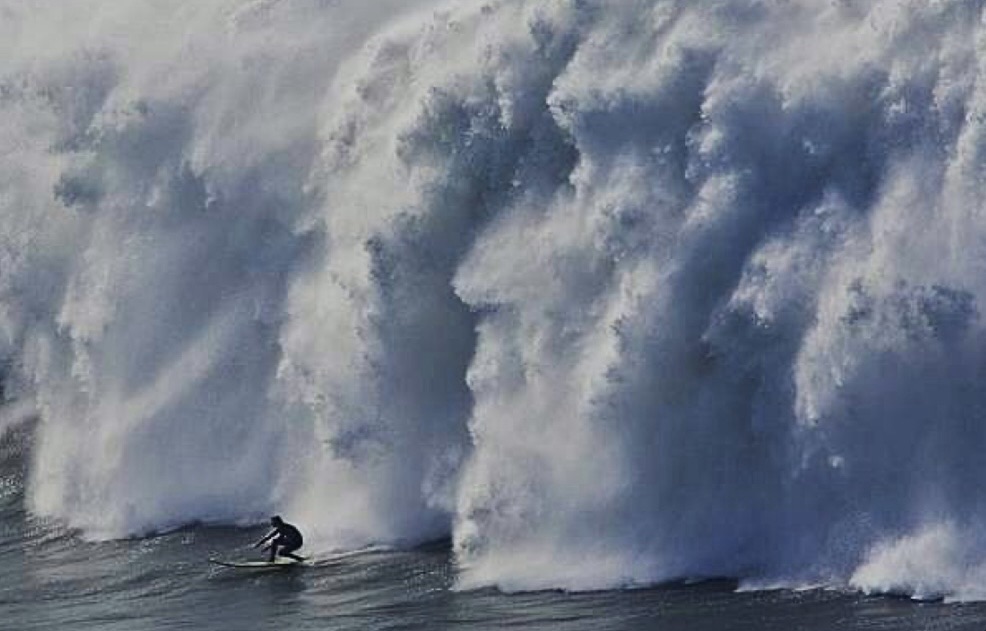
Overnight the swell has built into mountains of frigid water hurtling towards the coast; 15 feet tall and swallowing all in their path. What was pale blue water is now dark with the suspended pulp of their relentless hammering. The dusty headland – littered with pale Europeans basking outside their kitted-out campervans – is now the stands of a gladiator arena. All eyes are on the pair of surfers far below and the mammoth waves fast approaching.
Miles out to sea, the surface darkens and a dozen seabirds take flight. They’ve been spooked by an unusually large set of waves rolling beneath them. From the cliff, we can see towering lines licked by sunlight pacing towards the African coast. The two surfers aren’t fooled by the great distance; there are 20 seconds between each wave, and the clock is ticking.
The dark figure on the right – a wetsuit-clad stickman on a long white Gun surfboard – has been battling the white water for almost half an hour to get where he is now. He’d clambered over slippery rocks and into the churning white water a good kilometre away and has been following us on our walk round to the point. Every oncoming wave had thrown his board into the air, flung him to the depths and set him back the length of a football field. But through gritted teeth and coughing lungs, he’d persevered and been carried round to the point by the current. He’s now in the middle of the ring, and the bull is fast approaching. His determination is about to face the ultimate test.
His companion had paddled wide from the direction of the rain clouds over Agadir city, and gracefully climbed up each mound of swell before it’d broken into lashing waves. He’s now within shouting distance of the figure on the white board. Although gesturing wildly, his words are ripped from his mouth by the wind. Only sea spray reaches us on the cliff, but we know exactly what’s being said. The sheer scale of the sea state is lost to no one, with people pointing to the relative calm on one side and complete maelstrom on the other. To survive against these giants, they’ll need to turn right as soon as they catch the wave – if it doesn’t catch them first.
Suddenly, the sea is calm. The serenity is unnerving. Spray from the previous wave licks the air and paints rainbows over the subdued sea. The two surfers turn to face the cliffs, calculating their trajectory to intercept the next speeding mountain. Furiously paddling to gain speed, the pair are suddenly lifted high above the surface. The swell just hit the continental shelf and has raised a thousand tons of water into a glistening wall of fury.
The surfers pop up at the steep crest of the wave, and hang in freefall for a terrifying moment. Back at the point, the crowd is frozen in awe. Tourists hold their breath in anticipation. A tea vendor from the village stares with his mouth open, drinks spilling from the tray at his waist. Smartphones are raised, cameras are poised for action, and all eyes are on the lip of the bellowing wave.
What compels someone to risk their life for a wave, for a few moments of pure adrenaline?
I don’t know who these surfers are. Their background, journey to Banana Point, race, religion and beliefs are irrelevant. All that matters are these coming seconds. They’ve paddled themselves into this situation, and they’re either going to surf the wave or get crushed by it.
They drop in.
Plowing downhill, the pair carve white trails on the wave’s steely surface. The speed is blistering and their arms flail trying to stay balanced on their boards. In surf this size, the sport becomes a downhill discipline akin to snowboarding. Turning away from the rocks, the race is on to stay ahead of the white water, which is now throwing a mane of spray into the haze.
On the cliff, the crowd is ravenous. Shouts in half a dozen languages, cheers, fistpumps and applause ring out from the rocks. Seeing these gladiators face down a beast has scratched a tribal itch. It’s Theseus versus the Minotaur. Beowulf versus Grendel. Human versus monster.
I realise that very little about the surfers’ situation has improved – after half a minute of euphoria they’ll be back in the chaotic water, paddling for dear life. The only change from their prone state is the speed and control they show in the face of the sea’s might. They’re not battling the waves to defeat them; even an army of surfers couldn’t make a dent. King Canute couldn’t turn back the tide. They’re proving to themselves (and their rapturous audience on Banana Point) that they have the guts, determination and strength to perform this daring feat. I’m reminded of the warrior traditions of Plains Indians of North America, where the act of safely touching an enemy in battle (Counting Coup) was seen as the ultimate act of bravery – more so than killing them. It showed control, restraint and discipline that no act of violence could illustrate. These surfers have laid their hands on the swinging arms of the ocean, and ridden away into the blue unscathed.
Were they Moroccan locals or visiting tourists? It didn’t matter. For a minute, everyone on the point was transfixed by them. We all spoke the same language: primal exhilaration in the face of extreme danger. No differences in beliefs, cultures, finances, ethnicities or opportunities could break the unity we had in those moments. All humans are hardwired to admire mankind’s relentless survival against the force of nature.