Joel Thornton
My friend and I have a shared playlist we’re always putting interesting new rock stuff into for the benefit of the other. It was here that I heard Softcult for the first time – last summer’s big dreamy single ‘Naive’. It was musically somewhere between Slowdive and Cocteau Twins, and entirely up my alley. Good find, Phil.
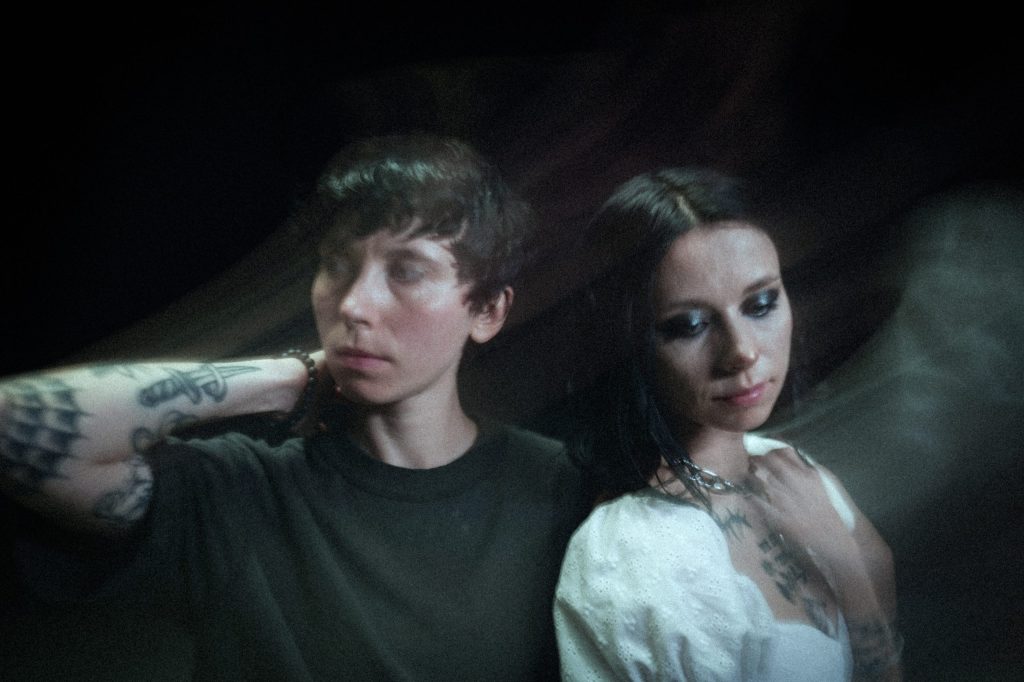
Canadian twins Mercedes and Phoenix Arn-Horn self-describe their sound as “riotgaze”, and it’s an apt description, despite sounding like something that won’t work on paper. This is because the portmanteau doesn’t necessarily split evenly into their songs or structures, whereby the general vibe of hazy walls of sound are pierced by punk-rock edge or frenzied snarling. It’s merely two separate aesthetics they’re very comfortable utilising, and this has proved to be a winning formula on a string of EPs so far this decade.
Despite such releases, January’s When A Flower Doesn’t Grow is their debut full-length album.
‘Intro’ is one hundred seconds of essentially nothing: some meek keys and a transition out into track two, which doesn’t justify its existence. I tend to rabbit on about the ‘art of the album’ in such instances, but I’ll let this one slide. It’s a bloody intro, named as such.
The arrangement of ‘Pill to Swallow’ beautifully mirrors its subject matter – the swathe of jangling guitars seem every bit as suffocating as the world Mercedes Arn-Horn finds herself in. However, there’s a touch of angst to be found in the apathy, both in lines like “don’t give in/bend until you finally break” and the deep pops of the snare drum. There’s a really delicate pop sensibility on display here that continues throughout the album: a real veteran sense of picking moments where the vocals shine, which is really not an easy feat with so much in the mix.
The aforementioned ‘Naive’ is a similar song, all things considered; it wields another watertight melody with some memorable drumming punctuating the main riff. It’s sharp work and it’s over a little too soon.
’16/25′ makes me cringe, but not because it’s bad. It’s a scathing takedown of the predatory behaviour of fully grown men, accosting and coercing teenage girls. If you get through “she doesn’t know how to love you/she doesn’t know how to drive” without wincing a little bit then you’ve got a stronger stomach than I do. It has all the grit such a subject warrants and the bassline is killer. I don’t want to say it’s a much-needed change of pace, but I’m happy it sits here in the listing.
Midway point ‘Hurt Me’ has two incredibly distinct halves. The first is even more fiery than ’16/25′, with a series of incensed outbursts to which Courtney Love would surely give the nod. The second half pumps the brakes to sit in its concession and consider what all of this anger means for the future.
‘Queen of Nothing’ is an interesting outlier, being more of a moody indie-pop song than anything else featured. Those jangling guitars return, but when isolated to a single track, the feeling is entirely different. Arn-Horn discusses the hardships of being a woman in a “man’s world”, that she “can’t live in…for free”.
‘Tired’ is very short, at a little over a minute. With this one, however, I’m glad. Not just because it is the classic punk sprint to the finish and would be weird to drag out, but also due to it being easily the weakest thing on the record. I tend to give a lot of leeway to the lyrics in these kinds of songs, but “tired of your expectations/tired of your explanations” is so beyond cliché it’s bordering on offensive.
Plinky acoustic guitar opens the title track, and I can already feel the build. I touched earlier on the general feel for production that the pair possess, and never is it more evident than here. This kind of playing with dynamics is typical of a closer, but perhaps not typical of the unconfident work often found on a debut LP. Everything flows along in order to get to the big finale of punched chords and it feels completely deserved, and absolutely cathartic. They question the things that end up defining us – whether they are just happenstance or part of the endless toil between a good option and an available one. “Do we blame the dying rose/or the soil that called it home/and the roots that yearned for the unknown?” I’m now absolutely offended by the lyrical tenuity of ‘Tired’.
It’s pretty well documented at this point that Gen Z have a huge hankering for alternative-rock nostalgia, with shoegaze (and its many relatives) being a central part of their chosen expression. And why wouldn’t it be? Our art diets imitate life much more often than art itself ever does, and there’s something definitionally messy, dreamy and longing about the genre.
To someone my age, this doesn’t seem like another revival wave. It seems like the same one that found me in my late teens and early twenties, that gave us Title Fight, Whirr, Superheaven, Basement. Don’t these things ordinarily lap around into fashion every 25 years or so? Still, it’s easy to pin our accelerated trawl through the ages in order to find comfort, on just about everything going on in the world around us. Mainstream shows like ‘Stranger Things’ and ‘Wednesday’ are even dipping into the pool, getting teenagers listening to Kate Bush and The Cramps.
This is all to say that the Softcult siblings are in a very good position. A modern outfit simply has to spearhead this for it to be any kind of movement, and if they can keep up the quality they’ve demonstrated so far, they seem very much primed to do so. When A Flower Doesn’t Grow is a mostly excellent, in-earnest outing for a band ready for bigger things.