Joseph Dimacchia
“Come on, it’ll be just like in the movies. We’ll pretend to be someone else,” muses Betty Elms, the ostensible protagonist of David Lynch’s now two-and-a-half-decade-old Mulholland Drive (2001). Betty (Naomi Watts) delivers this line to Rita (Laura Harring) – an amnesiac whom she has just met. The two are attempting to uncover Rita’s true identity, and the only clue they have is a purse filled with cash and a blue key.
There are a number of such moments in the first half of Lynch’s seventh feature film where its own artifice is openly recognised. The characters themselves, for example, are such discernible archetypes that one could seemingly pluck either one from any number of different works within cinema’s century-long history. Betty arrives in Los Angeles as the prototype of the endlessly optimistic ingénue. Rita, by contrast, operates as the simulacrum of the femme fatale, speaking little but with a mystifying radiance. As with typical Lynchian logic, something lies beneath the surface of everyday performance (also seen in Blue Velvet (1986) and Twin Peaks (1990–1992)). For the central characters in Mulholland Drive, however, their essence is found within such artifice rather than beneath it – a point Lynch makes clear in the early scenes of the film.
The opening frame, for example, is all song and dance: lurid, superimposed images of couples swaying the jitterbug whirl across the frame, a vibrant woman stands and accepts applause; we then cascade toward a pillow, seemingly to rest – and the dream begins. As the opening credits roll – accompanied by Angelo Badalamenti’s haunting score – Lynch immediately juxtaposes the two sides of the coin that is Los Angeles. A car moves along the film’s namesake road, inundated with darkness yet overlooking the vast, kaleidoscopic city lights below. From the first image, the film situates itself between glamour and void, both within its characters and LA setting.
So begins the illusion of Mulholland Drive – or more precisely, the dreamscape in which all cinematic forms and genres coexist. The most immediate of these is noir: Rita’s early car crash and the ensuing mystery regarding the bright blue key and purse of money all gesture toward a familiar narrative scaffolding. Yet I would venture to argue that the entirety of the film is a confection of countless cinematic or artistic references. Like any great Lynch work (they are all great), Mulholland Drive functions through its amalgamation of filmic tradition and a darker, more experimental brand of cinema. In this sense, the coalition of genre and tonality in the film further facilitates a distinct atmosphere in place of narrative coherence.
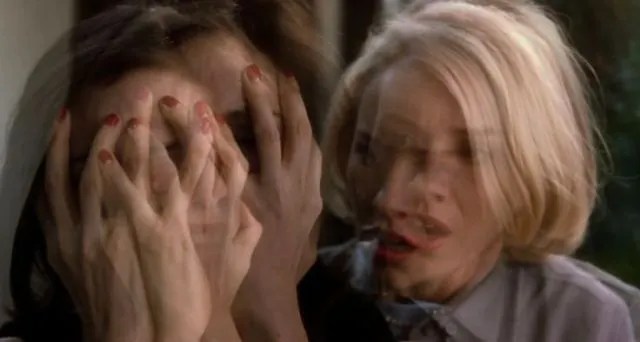
Yet, there is still something to be said – or at least contended – about the film’s plot structure. After Rita unlocks the blue box with the key found in her purse, the whispered line “time to wake up, pretty girl” marks a decisive fissure in the film’s ontology. We now follow Diane Selwyn (Naomi Watts), a struggling actress who resembles a more disheveled version of Betty, as she recalls memories of her former lover Camilla Rhodes (Laura Harring). Versions of players seen throughout the film also find their way into this parallel world. A filmmaker played by Justin Theroux, for example, is in a relationship with Camilla. The elderly couple with whom Betty flies to Los Angeles are now shown parading around a completely frightened Diane. The blue key that acted as a narrative catalyst in the early goings of the film is now used as confirmation for the hired killing of Camilla by Diane. The two separate realms often cross-reference one another – so much so that the audience is forced to make their own assertion as to whether they are separate at all.
This monumental repositioning of the film’s narrative, however, renders the first two hours far more essential. In other words, by bringing the audience into a harrowing newfound reality – thereby extracting them from the dream of Los Angeles – they can begin to reinterpret Betty’s muddled reality. Therefore, it appears that everything that has occurred hitherto has acted as Diane’s fantasy: being discovered in Hollywood, being without pain or heartbreak, financial struggle, desolation or any other anguish she has experienced. For instance, the infamous sex scene between Betty and Rita early in the film marks not only the apex of this fantasy, but of Lynch’s deconstruction of filmic convention. The scene is ostensibly hyper-erotic – a trope of the lesbian sex scene as shown through the male gaze. It utilises the same formalistic technique as many other scenes in the film: highly stylised and well-lit in a dim haze. However, once juxtaposed with Diane’s failing relationship and lack of intimacy, the aforementioned scene loses its erotic charge, henceforth subverting the scene’s voyeuristic expectations.
By this logic, Lynch consistently invokes typical filmic banalities, only to deconstruct them in the end. By filmic, I also mean Los Angeles. To Lynch, the two are seemingly inseparable, acting as one sweeping dreamscape. His understanding of the city that birthed his expansive career is evident in the film’s dual characterisation. In many ways, it is Rita’s inability to recall her past and Betty’s unfamiliarity with Los Angeles that speak to one of the more prominent themes in the film: that two-sided coin of Los Angeles: one side promising wealth and glamour, and the other depravity and violence. Mulholland Drive takes on this metaphor, eliciting the dream that is Los Angeles first, only to flip the coin to reveal a world of anguish and degradation.
Thus, the immense beauty of Mulholland Drive – and Lynch’s entire oeuvre – is perhaps the notion that an audience can subject themselves to the images before them, and regardless of outcome, a visceral reaction occurs. Perhaps no other director has understood Los Angeles or cinema quite like David Lynch: the haze in the air, the palm trees painted against blue skies, the fear of failure looming, the pressures of being, the pictorial image as dreamscape, the smell of night-blooming jasmine. If nothing else, Mulholland Drive is like the dreams we have each night when we lay down to rest. When the film is over, we wake up and the dream is both inexplicable and intensely palpable.
Featured image credit: Universal Pictures