Sienna Bentley
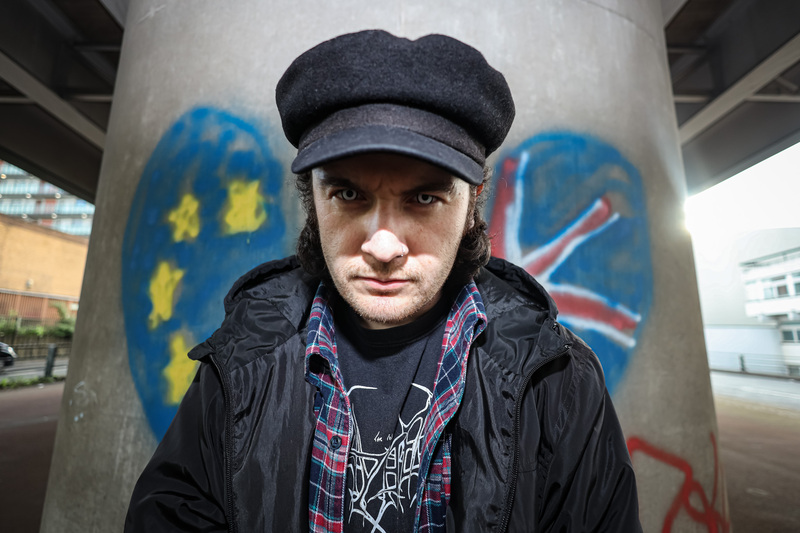
First to sit down on the grass with us at CloseUp Festival on the bank holiday weekend were Liverpudlian band Monks, who are rewriting the rulebook. Comprising synthesist/keyboardist Liam Daly, drummer/beatmaker Kali Diston-Jones, guitarist Nathan Johnson and lead singer George Pomford, the band blurs the line between electronic and indie, making for a live set that is equal parts energetic, punchy and fun.
Kali and Nathan, undeterred by the 30-degree heat, opened up about how their sound has evolved over time and what unexpected skills they’ve had to learn to facilitate that shift, how they reconcile creativity with the necessity of a 9 to 5, battling demo-itis, and their definitions of success.
And, of course, the importance of balance.
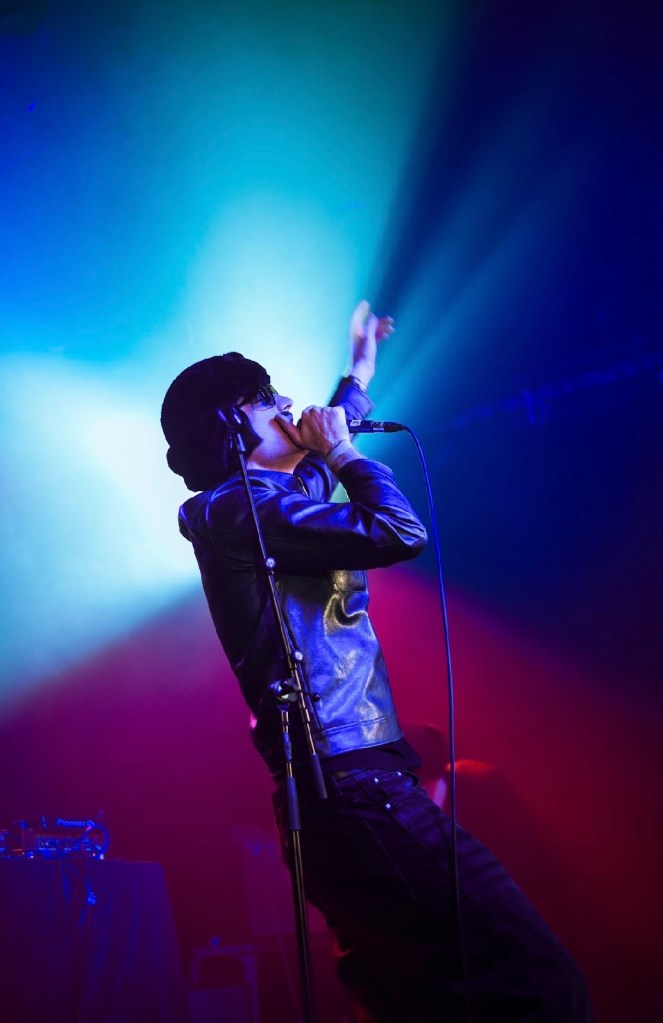
Credit: Scarlett Cannon
What other work pays your rent, and do you find that it feeds or drains your creativity?
Nathan Johnson (NJ): So we all sort of have jobs within the music sphere, which is good in some ways. Kali, you’re a music teacher. I work at a music publisher as an assistant for copyright with George [Pomford], but he does a bit more creative stuff and I do a lot more admin. Liam works as a teacher in a school, not music related.
I’m very lucky to be there, but the main goal for us is to be musicians. Well, I’ll speak for myself, maybe not you, Kali. I just want to do music full time – as in performing – because that’s the dream job. When you’re in the music world but on the business side, you see the other side of the industry. It’s great to have the knowledge and I think that knowledge definitely helps us as a project, but I see the other side of it, which is the less glamorous side where artists are missing money, and at other companies, artists can receive less royalties than they deserve. I’d say it’s positive overall, but the dream is to be in a band and not work an office job.
Kali Diston-Jones (KDJ): Yeah, so we’re half publishers, half teachers. My job’s more specialised in music – I teach music in Liverpool at sixth form level. They’re great kids.
We’re lucky that we can be in the music world for our jobs. I develop my skills at work – yes I’m teaching, but we’ve also got the facilities and equipment for me to keep doing my own development, so I’m very lucky.
I do like the balance, I’m a bit different. It is nice when you’ve got to be in front of people, you’ve got to help them. I still use all the skills that I do with the band, so it’s a weird sort of crossover – for example, I teach some production and then I go and do it with the band, so I can’t complain. It’s all about balance.
NJ: I’m lucky I work for a really, really good company, which is very artist friendly. They pride themselves on an 80-20 split for clients as their standard deal. It started as a very small independent company by a guy in Liverpool so it’s grown bigger but it’s a really nice place to work. They have the artists’ best intentions at the forefront, whereas if you work for a major label or publisher, they’re more thinking about money all the time rather than developing new talent, or they’re developing talent for the wrong reasons. I truly believe Sentric is pushing new talent on and they invest in it.
Do you feel like a musician first, or something else?
KDJ: No matter what you do in life – and I think it’s more of a life outlook – music’s always first and foremost in whatever. It takes you wherever you go, it comes with you.
NJ: I definitely say I’m a musician. Since being a teenager I’ve just always wanted to be a musician. We always tell people we’re musicians when we go away, don’t we? It just always opens up a little conversation.
KDJ: You just take it with you. We have had amazing experiences where it’s a bit of a holiday, really, we travel together and the things that come from it are incredible. Music is the great socialiser in my opinion.
NJ: Yeah and people are always interested when you say you’re a musician, it opens up a conversation, so it’s great, every day. It’s all worth it. But sometimes you have to justify that you’re an artist. If someone asks you what you do, people will maybe ask if you’re a “real artist”. I imagine people think that first, but I don’t know – Kali, when someone asks you what you do, what do you say?
KDJ: I think it’s tough, whatever pathway, university or degree you go and do, I feel like that’s the way the world is – the way the world’s gone. There’s this outcome-obsessed mindset now. But really, even though that’s in the back of your head, you’re just like fuck that. In the precious moments you get to create something, once you’ve done the work, you’re like fuck that, let’s just make something, whatever it is and not care as much about outcomes. This is easier said than done, though.
There is that money-oriented perspective, always. I think that would always be the case. If you go too far that way, you stop enjoying it, and if you go too far the other way, then you kind of get lost as well, so it’s all balance. I just say balance. Every question: balance.
What’s the most unexpected skill you’ve had to learn to keep your music alive?
KDJ: I think, for me, DJ’ing.
NJ: I’d say it’s a collective thing – we started off as a little bit more of a dream-pop psych band a few years ago when we were only kids/teenagers, but we’ve gotten obviously more electronic/dance sounding, but what comes with that is you have to learn how to DJ.
KDJ: We’ve switched the whole thing up. We haven’t just changed the sound up, it’s the way we work together, the way we make things, the workflow and the skills needed to execute it. This is our third time playing this venue in London and it’s the first time I’m on the decks. We played with drums and another member before. I wouldn’t have said that I’d be DJ’ing in a classic “where do you see yourself in five years?” way, so the most unexpected skill has been DJ’ing and then putting it into the band setup as well.
NJ: That’s something we don’t really see; we have a lot of friends who DJ and a lot of friends who are in bands, but we wanted to combine the two to make an electronic world but have the live elements in there to make things interesting in our performances.
KDJ: It’s a collective job – George DJs, Liam’s getting into it as well, now it’s you [Nathan] next.
Where do you draw the line between authenticity and strategy with social media?
KDJ: Well, we’ve tried things in the past and the current state that we’re in, I think if people are good at TikTok, do it, if you’re not good at it, don’t, simple as. For this project, it’s like, where do you want to place yourself? It’s like fucking Betfred – posting on TikTok and waiting to see if it does well. But we don’t actually want to do it. I think you just know in your soul. It’s not right for our project.
NJ: Obviously it’s important to put yourself out there strategically on social media. But that’s not why we make the music. We’re not sat making music thinking, “oh, this one will do well on TikTok” or whatever. We just do the art, and then that comes secondary. We just post what we’re up to.
KDJ: You just know when something’s inauthentic. And I don’t know, I get scared because I work with young kids and it’s like, they’ll do anything for a few views. It’s like this quick, quick, fast-paced economy.
NJ: Yeah, I was sat in a coffee shop yesterday or the day before and there was a guy filming TikToks in there while I just sat off to the side. And I was thinking, is this what the world’s like now? I’m probably in the back of some famous TikTok and I’m just sat there having a cappuccino. I didn’t really understand what was going on. He kept on filming random stuff. I was just like, what is this? Can you not even enjoy your coffee anymore?
KDJ: I think, really, it comes down to: you know if it’s right for the project. Even if we were great at TikTok, is it right for what we want to do, where we want to place ourselves? But then I feel like you’re made to feel like there’s no alternative.
NJ: We know a lot of people who are really good at social media but that’s sort of like their art form coming out on socials, so I think it can be used well strategically in that way and you can express yourself on it, but our project doesn’t really fit into that, we’re just more thinking about the music and releasing music. We think about the image and stuff but not really from a socials perspective, more just from a live performance perspective.
KDJ: I think deep down these days there is a bit of a rebound where some are starting to see through it all. I still don’t know what the general public thinks… I don’t get them.
NJ: You sound like Alan Partridge. “I just hate the general public.”
KDJ: I don’t know. You’re made to feel a certain way about it, in all industries. But when you get away from it a bit, you do get a bit of perspective.
What does success mean to you?
KDJ: At different times of our career everyone’s got different… not priorities, but you follow things, you want to see where things go. For me – and maybe it’s the way the world’s gone – it’s being content and having balance. I am lucky to like my job. I think when we do this, the pro is that it makes days like today even more fun. Not going too far one way or the other.
NJ: Success for me is us liking the music and people liking the music, to be honest. I think as long as that stays, that’s success to me. When we play live, we do get quite a good reception, so that helps you continue to believe in yourself and in the project.
The industry probably sees success as making money and big, massive artists it can make a lot of money out of – and that is also success for me in some ways, I’m not opposed to it, but if I was to say I’m successful as a musician it would be if that’s my main income and I can live a steady life off of it.
Now you’ll come and watch us and go: “Oh they’re terrible. Don’t give up the day job fellas.”
[We didn’t do that.]
What’s the most DIY solution you’ve used to make an idea work?
NJ: We’re quite DIY artists, aren’t we? When we didn’t have a live agent or anything we had to book our own shows and send emails out to people.
KDJ: The boys have taken on a lot of the managerial roles – the admin and day-to-day stuff – and these days we all split different things up. I’d say producing our own songs is a big one. We use Ableton now, I made the dark switch from Logic.
We go in and out of working with different people and people help our projects but we’ve actually weirdly gotten to a point where now I’ll be going to the boys “let’s get someone on this”, and then they go “no, the raw demo is what we want”. So I guess making our own stuff and managing ourselves.
Do you ever get demo-itis?
KDJ: Oh my God.
NJ: Oh yes, yeah, Jesus Christ, all the time.
KDJ: Do we get demo-itis? I’m like “let’s throw more on it”, the guys are like “nah it’s sweet”.
NJ: We do have a very DIY setup and we produce the music ourselves, and Kali is so good at producing music – he gets it to too good of a level where we don’t want to give it away to someone because we like how it sounds – really we just need someone who can maybe enhance what we’re doing.
KDJ: We’ve done a few different workflows in our time and that’s been amazing. And I think that all informs what we do now, because we’ve worked with a lot of different people and we’ve had an amazing time with it.
What can you do in an intimate venue that you can’t do on a big stage and do you feel more exposed or empowered when the crowd is that close to you?
NJ: The biggest we’ve played was the Liverpool Olympia with 2,000-odd capacity. That felt a bit too soon for us, we were quite young at the time.
KDJ: I like the equipment on stage at bigger venues and the lights. We’ve gotten really into lights and we’d love to be able to do it ourselves but in terms of where the music’s gone, the whole package of not just the sound but everything that comes with it, we want lights when we can get them. I think there’s a happy medium with it.
NJ: When a venue’s too small it’s scary.
KDJ: He doesn’t like the little ones.
NJ: People see how bad my guitar playing is. You can get away with it on the big stages.
KDJ: We like trying a few different things. We just did The Great Escape and another festival playing a lot of different venues within the weekend. To contrast what I’ve just said, being able to turn up anywhere and go right, just fucking get stuck in there. Even though we’re an electronic band, we still want that thing of being able to just turn up somewhere and do it.
NJ: There’s beauty to both of them. The big stages are always fun, but the smaller venues are almost more fun because you can actually see the crowd and feel the audience.
KDJ: But then I love the equipment on the big stages, the monitors. A lot of our music is dance-y, so when the low end comes out on a big PA, you get a good feel for it. And the light rigs are amazing. But it’s all balance. That’s all I’ll ever say.
If you guys came back to CloseUp next year with an unlimited budget, what would you build?
KDJ: My instant answer is dancers. Fully choreographed dancers. I’m just going off the first answer that comes into my head, but I’d have two dancers and a proper choreographed routine. Full black rig outs, sunnies on, with the hats on that we all wear.
NJ: Yeah, I like that answer.
What is something that you’ve learned about each other that only comes from making music together?
KDJ: It’s more of a deep level for me. I’ve learned how the guys work as people, the guys have learned how I work. That’s literally it. You learn about people. We’re all different, like fucking hell, we’re very different, but it’s like a family.
Monks recently released a new single, ‘new machine’. We’ve had it playing constantly – you should too. My housemate agrees it’s a banger, so if you don’t trust me, listen to her.