Benjamin Murphy
Ngai Ning Yu is an artist who is gaining recognition in the art world at a rapid rate. As well as being the overall winner of the Delphian Open Call 2025, since graduating from Camberwell 2025 she has been chosen as one of Saatchi Art’s Rising Stars of 2026, and been awarded the Christopher Seow Student Award First Prize 2026, the Derwent Special Fine Art Award 2026, Shortlisted for the Well Hung Painting Prize 2026, and Longlisted for the Jackson’s Art Prize 2026.
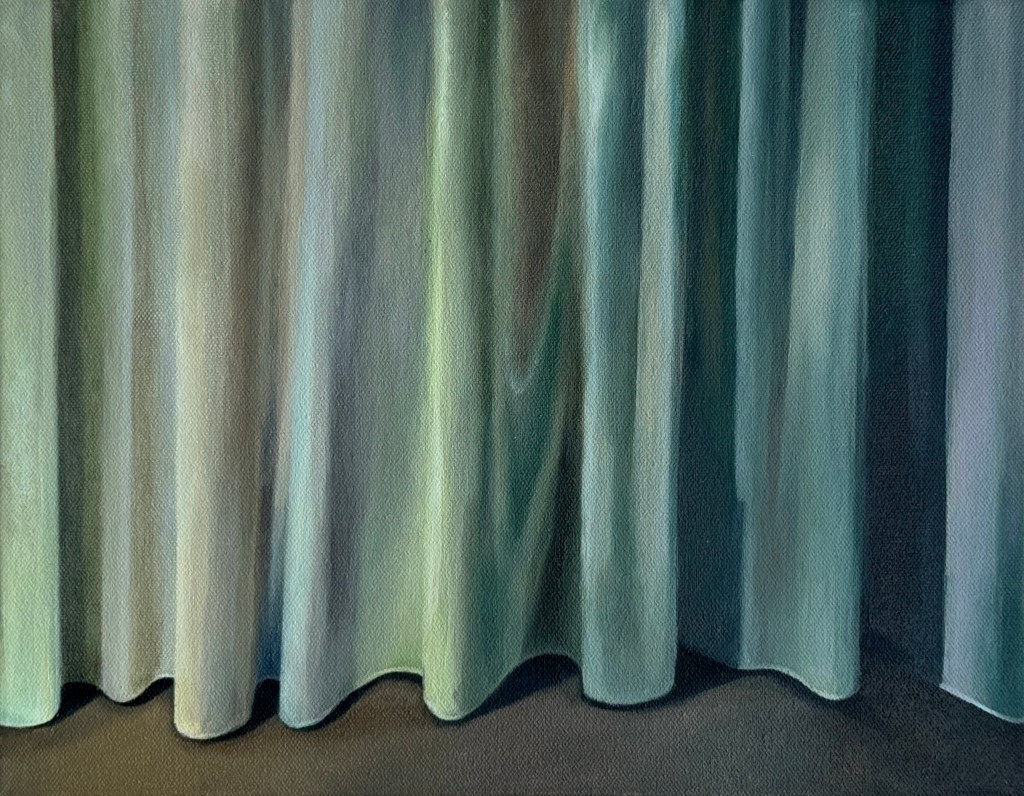
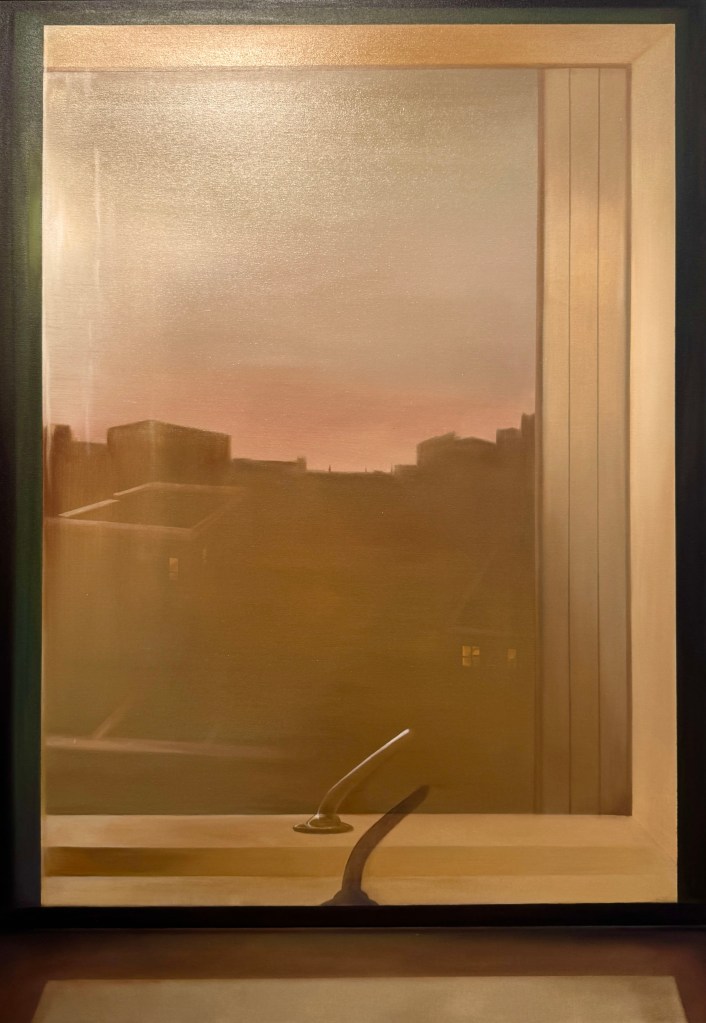
Her current work features calm, liminal spaces like windows and doorways. Often thinly veiled with ethereal curtains gently moving in the breeze, they act as both barriers and entrances, obscuring what happens beyond while enticing exploration. Rendered in oil paint onto canvas, Yu is somehow able to make this thin fabric feel as if it is truly the only thing separating the inside from outside, the only thing stopping what is without becoming within.
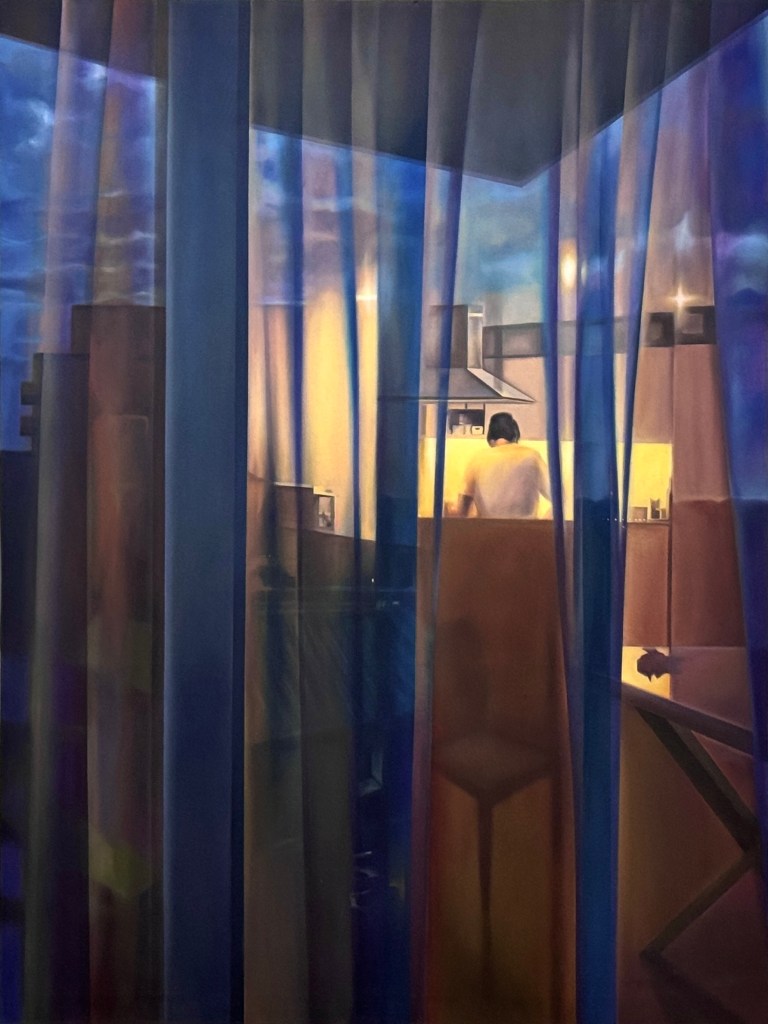
The concept of home only begins to exist when there is an emotional disconnect between the currently inhabited space and the longing for a place that one has left behind. It is this dichotomy that The Weight of Invisible Spaces explores – the house and the home.
As an artist transported out of her home, Yu feels this disconnect and uses her work as a way to exorcise it. Born in Hong Kong but now working in London, Yu feels that displacement acutely. When there is a sense of absence in a painting, one feels the urge to inhabit it, to step inside. When we enter a painted space and reside in it, we leave our surroundings behind and are transported into the intimate space of another, a space we may not know, but recognise its semblance in places we once knew elsewhere.
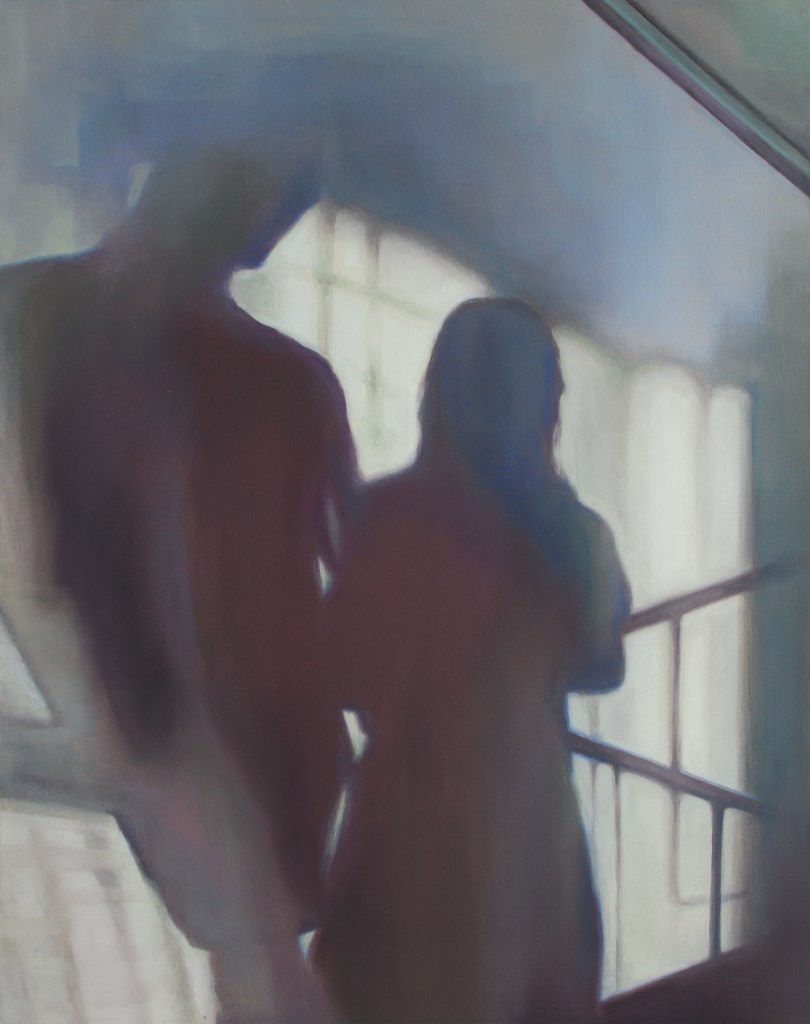
My practice explores the notion of ‘home’ as an emotional space of belonging, where memory can be revisited through light and shadow. These isolating yet universal revelations on nostalgia, memory and loss largely inform my work. I like to employ the motific nature of domestic landscapes and the liminality of light and space to create tangible tension, a collective aloneness reflective of the dichotomy between the inner mind and the exterior world. I work from photographs and memories of significant places I have once inhabited, and I like to hide the figures within my compositions, so that they are seen through their shadow silhouettes or obstructed by another layer of space, existing only as an echo that draws on my sentimentality towards a certain time and place.
Why are you an artist?
Yu: I think one of the main reasons is how much I love the process of making paintings, being able to step away from the external. It’s like escapism and the painting process leaves me in a separate headspace where I’m between what has happened and what will happen – while also considering how those states impact the work. I think that’s also why I like to paint quiet things that I think people leave unsaid but are still present.
Why is stepping away from the external something you feel a need for?
Yu: Likely due to the sense of burden I can feel from the fact that nothing stays, it all becomes a memory and the amalgamation of human experience can translate to a feeling of loss. It doesn’t mean that everything is miserable and pessimistic, but I tend to hold on to the sentimental things that I know can’t be experienced again. So I guess part of my paintings is bringing pieces of that back.
Do you ever feel like you are missing out on the now because you are trying to hold onto the past?
Yu: Time dulls memories and you lose bits of the detail of what made an experience beautiful or painful. I still find solace in remembering, but I think I’m seeing it differently now – treasured past experiences feel more and more distant and I’m finding resonance with what exists presently.
These days, it’s how I find a lot of my imagery to work from, and I also like how my work indicates the emotion that was felt at the time I made it. When I started painting after moving to London it was definitely in the way of looking back at what once was, and it was all I could really think about to cope with a feeling of uncertainty.
Do you feel less uncertain now after a few years in London? If so, how do you think that will affect the feel of the works?
Yu: Yes, I feel grounded in the familiarity. I can notice more, I’m really into the quietness of an interior space from the outside looking in. Lately I’m thinking a lot about places that have a ‘double exposure’ effect. For example, I’ve had my studio since I graduated last year, and it’s near the community I was living in when I first came to London. So when I walk the same paths that I used to five years ago, the same high street and familiar roads, it leaves me kind of in between. As my past associations become written over by new experiences in the same place, I’ll start to forget how some things used to look like, and I think this could be really interesting for my next paintings.
Do you worry that the memory of Hong Kong will fade the longer you’re in London?
Yu: It’s funny, things fade with time but nothing really goes away. While memories become less vivid, they stay beneath the surface to be unearthed. A specific smell or texture of light and I remember it all again. Whenever I dream of my house, it’s always my childhood home in Hong Kong. I’ll let the details go, but it’s nice to know they remained ingrained in me and my work.
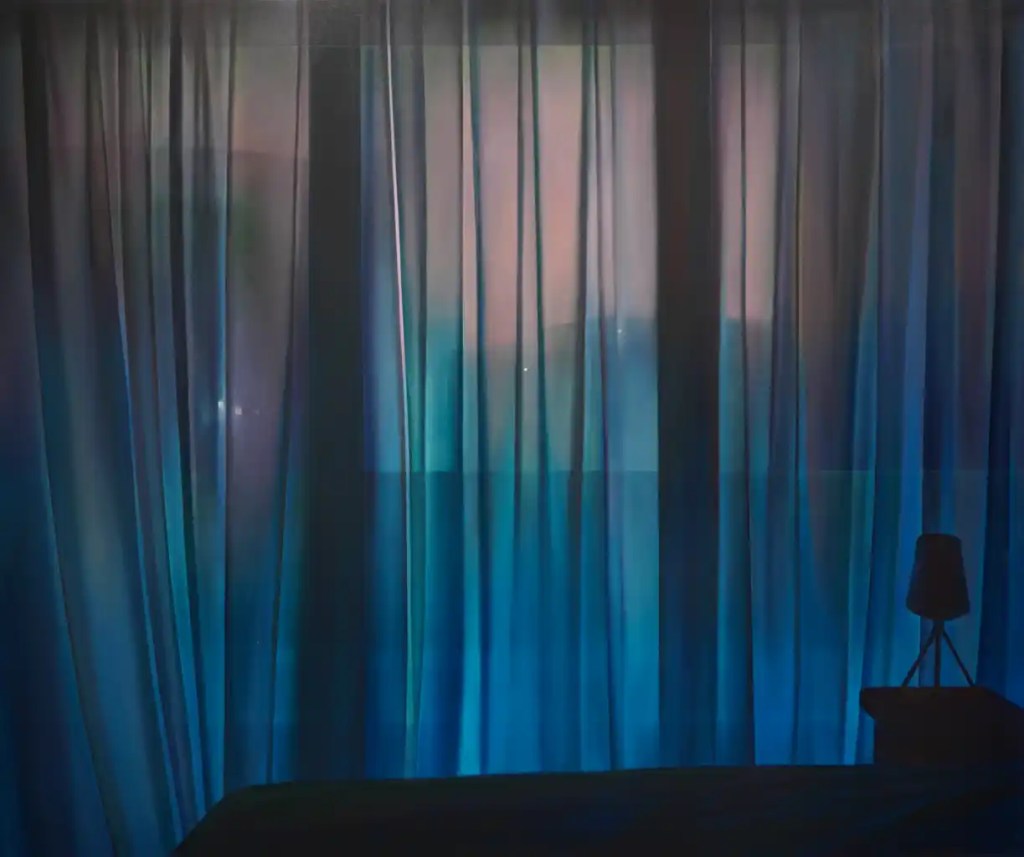
Your work seems somewhat voyeuristic, as we look in on the intimate lives of others without their knowledge. Do you ever feel like you’re giving something away when you paint these works, like you’re letting people into a place so personal?
Yu: I paint these scenes for myself, really. I am happy that other people resonate with the imagery, I think it’s more to do with the nature of an empty space. It gets filled by whoever’s looking at it. I love the possibility of sharing that very human experience. When a painting is done, I feel it transform into a still scene, somewhere to be returned to. I find catharsis in this universal resonance towards something personal.
Tell us about your upcoming show at Delphian Gallery.
Yu: I wanted to explore the way memory inhabits space. The paintings I’ve chosen to exhibit are quiet, even the largest ones. Domesticity is very present, and I paint the image of my mother as the woman behind the curtain; she comes into my work a lot. I like to paint the ephemeral moment, capturing and collecting one precise point in time. So visually, I liked the collective transition of colour from warm to cool across this body of work, as a subtle indicator of time passing.
Private view: 22 October 2026, 6-9pm
Show run: 23 to 30 October 2026
Address: Unit 1, 1 Bard Rd, London W10 6TP
Exhibition supported by Unit 1 Gallery & Workshop